Have you ever joined an online game and struggled to understand what other players were saying? You might know basic English, but phrases like “LFG dungeon,” “Need more XP,” or “I’m grinding mobs” can still sound confusing.
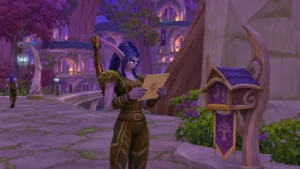
World of Warcraft: Forever offers a useful setting for learning practical gaming English. Players communicate while completing quests, exploring Azeroth, improving equipment, and joining groups. These conversations often combine everyday English grammar with gaming-specific expressions.
Understanding these phrases can help learners improve their vocabulary, sentence structure, and communication skills while becoming familiar with common MMORPG terminology.
“I’m Leveling My Character” vs “I’m Level 40”
These expressions look similar, but they describe different situations. “I’m leveling my character” describes an activity happening over a period of time. The sentence uses the present continuous tense.
Its structure is:
Subject + am/is/are + verb-ing + object
For example, “I’m leveling my warrior” means the player is working toward higher character levels.
“I’m level 40” describes the character’s current state. The sentence uses the present form of the verb “be” followed by a level designation.
Compare these examples:
| Sentence | Meaning | Grammar |
| I’m leveling my mage | An ongoing activity | Present continuous |
| I’m level 40 | Current character level | Present simple with “be” |
| I reached level 40 | Completed progress | Past simple |
| I’m trying to reach level 50 | A current goal | Present continuous |
Understanding “Level Up” and “Boost” in Gaming English
“Level up” is a common phrasal verb in online gaming. It means reaching a higher character level.
For example, “I need to level up before joining the group” means the player wants to increase their character’s level.
The phrase can also appear in different tenses.
“I leveled up yesterday” uses the past simple.
“I’ve just leveled up” uses the present perfect to describe a recent achievement.
Another useful word is boost. In gaming English, boosting means receiving assistance or using a service to reach a progression goal more efficiently.
For instance, the expression wow forever leveling boost refers to assisted character-level progression in WoW Forever. Here, “leveling” identifies the objective, while “boost” describes the assistance involved.
Players may also say, “Can you help boost my character?” This uses “boost” as a verb. The word also works as a noun: “I’m looking for a leveling boost.”
These examples show how one word can have different grammatical functions without changing its basic meaning.
Common English Expressions for Finding Groups
Group activities are an important part of MMORPG communication. However, players rarely type complete sentences every time they need teammates. Instead, they use shortened expressions.
What Do LFG and LFM Mean?
LFG stands for “Looking for Group.” A player might write, “LFG dungeon.” In complete English, this means, “I’m looking for a group to complete a dungeon.”
LFM stands for “Looking for More.” It usually means an existing group needs additional players.
For example, “LFM healer” means the group wants someone who can perform the healing role.
Another expression is “LF1M,” meaning “Looking for one more.”
These phrases omit subjects and other grammatical elements because players want to communicate quickly. In formal writing, complete sentences are generally more appropriate.
How to Ask Players to Join a Quest or Dungeon
Polite questions are useful when communicating with unfamiliar players.
Consider these examples:
“Can I join your group?”
“Would you like to complete this quest together?”
“Do you need another player for the dungeon?”
“Could you help me with this quest?”
The modal verbs can, could, and would help form requests.
“Can I join?” is direct and friendly.
“Could I join your group?” sounds slightly more polite.
“Would you like to join us?” is an invitation rather than a request for permission.
Talking About Gear and Equipment Upgrades
In WoW Forever, players use equipment such as weapons and armor. The common gaming word for this equipment is gear.
For example, “I need better gear” means the character needs improved equipment.
“Gear” is generally an uncountable noun in this context. Players usually say “some gear” or “a piece of gear,” rather than “a gear.”
The word “upgrade” can function as both a noun and a verb.
“I found an upgrade” uses it as a noun.
“I want to upgrade my weapon” uses it as a verb.
Another expression is “I’m gearing up.” This means the player is working on obtaining or improving equipment. Notice that “gearing up” can also mean preparing for something in everyday English.
Explaining That You Need More XP or Resources
Players frequently talk about experience points, gold, and crafting materials. XP is short for experience points, which contribute to character-level progression. Consider the sentence, “I need more XP to reach the next level.”
The structure is:
Subject + need + more + noun + to + verb
The same pattern works in other situations.
“I need more gold to purchase equipment.”
“We need more materials to craft this item.”
“I need more time to finish the quest.”
Asking Where an NPC, Quest, or Dungeon Is Located
Players often need directions when exploring unfamiliar areas. An NPC, or non-player character, is a character controlled by the game rather than another player.
Useful questions include:
“Where is the quest giver?”
“How do I get to the dungeon entrance?”
“Can you show me where this NPC is?”
“Is the quest available in this area?”
Notice the difference between direct and indirect questions.
Direct: “Where is the quest giver?”
Indirect: “Could you tell me where the quest giver is?”
Understanding Common MMORPG Vocabulary
Several gaming words have meanings that differ from everyday English.
Grind, Carry, Main, Alt, and Mob
Grind means repeatedly performing activities to gain XP, reputation, or resources. “I’m grinding mobs” means repeatedly defeating enemies for a particular objective.
Carry means helping another player complete content by doing much of the difficult work. “Our group carried a new player through the dungeon” illustrates this meaning.
Alt is short for alternate character. “I’m leveling my alt” means the player is progressing another character.
Mob refers to an enemy creature or character encountered in the game.
Other useful expressions include “tank,” a role focused on managing enemy attacks; “healer,” a role that restores health; and “DPS,” which refers to damage per second or a damage-dealing role.
Informal Gaming Chat vs Formal English
Gaming conversations are usually brief, especially during combat or group activities.
Players commonly use abbreviations such as:
“BRB” means “Be right back.”
“AFK” means “Away from keyboard.”
“OMW” means “On my way.”
“GG” means “Good game.”
“TY” means “Thank you.”
A player might type “omw dungeon” instead of “I’m on my way to the dungeon.”
Although the shorter expression is understandable in gaming chat, it omits words required in a standard complete sentence. The difference is mainly about context. Informal communication prioritizes speed, while formal communication generally requires clearer sentence structure and conventional grammar.
How to Improve English Through Gaming Conversations
WoW Forever terminology can help English learners understand how vocabulary changes depending on context. A useful approach is to take a short gaming expression and rewrite it as a complete sentence.
For example, change “Need healer” into “Our group needs a healer.”
Change “Where NPC?” into “Where is the NPC?”
Change “Got better gear” into “I obtained better equipment.”
This practice develops sentence-building skills while keeping the meaning familiar. It also helps learners recognize omitted subjects, auxiliary verbs, articles, and prepositions.
Conclusion
Learning English through World of Warcraft: Forever is about more than memorizing gaming vocabulary. It also involves understanding verb tenses, phrasal verbs, polite requests, sentence structure, and informal communication.
Expressions such as “I’m leveling,” “LFG,” “I need more XP,” and “Can I join your group?” demonstrate how English works in practical conversations.
By understanding both the gaming meaning and the grammar behind each phrase, learners can communicate more confidently with other players while developing useful everyday English skills.
Also Read
- The Ultimate Annual Home Maintenance Guide to Prevent Costly Repairs
- FML Meaning in Texting: Examples, Context, and Best Replies 2026
- Snowball Kiss Meaning: What It Really Means and Why People Do It