If you’ve ever seen the term CQB in a military documentary, tactical game, police report, or training discussion, you may have wondered what it actually means. CQB is one of those acronyms that sounds familiar long before its full meaning becomes clear.
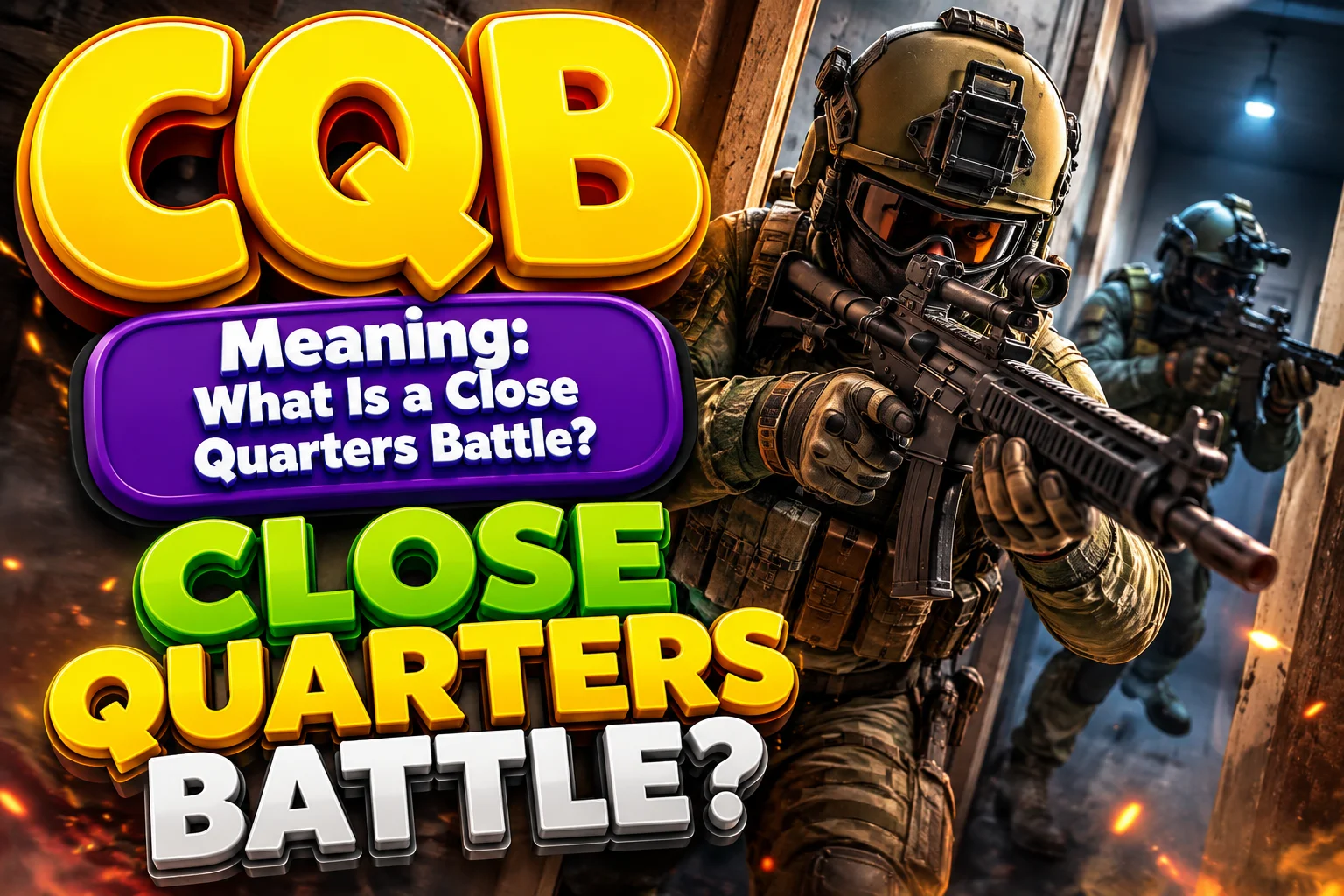
CQB stands for Close Quarters Battle. In simple terms, it describes combat that takes place at close distances, often within confined or restrictive environments where space, visibility, and reaction time can dramatically affect what happens.
CQB commonly comes up when people discuss fighting inside buildings, rooms, vehicles, ships, tunnels, or other enclosed spaces. However, the term isn’t limited to one type of building or one particular military unit. Different organizations use CQB in slightly different ways depending on their mission and training systems.
The concept also gets blurred by movies and video games. Fiction often portrays CQB as nothing more than fast movement through rooms.
Real-world CQB is much broader. It involves environmental awareness, communication, coordination, identification, decision-making, and disciplined action under extreme pressure.
Quick Answer
CQB means Close Quarters Battle.
It refers to combat conducted at close distances, particularly in environments where limited space or restricted visibility affects movement and decision-making. Common examples include buildings, rooms, corridors, vehicles, ships, aircraft, tunnels, and other confined spaces.
CQB is strongly associated with military and specialized law-enforcement operations. However, the acronym also appears in gaming, airsoft, tactical training, and popular culture.
A useful way to remember the definition is:
CQB is combat where distance and restricted space fundamentally change how an engagement unfolds.
CQB isn’t simply another name for hand-to-hand fighting. It also isn’t exactly the same thing as room clearing or urban warfare.
CQB at a Glance
| Question | Answer |
| What does CQB stand for? | Close Quarters Battle |
| What does CQB mean? | Combat conducted at close distances, often in restrictive environments |
| Is CQB only military? | No |
| Is CQB the same as CQC? | They overlap heavily, but usage varies |
| Is CQB the same as room clearing? | No. Room clearing is narrower |
| Does CQB always happen indoors? | No |
| Is CQB the same as urban warfare? | No. CQB is generally a more localized combat problem |
| Does CQB mean hand-to-hand combat? | No |
Comparison Overview
The easiest way to understand CQB meaning is to compare it with the terms that frequently appear alongside it.
| Term | Full Meaning | Main Focus | Typical Scope |
| CQB | Close Quarters Battle | Close-range battle in restrictive spaces | Localized combat |
| CQC | Close Quarters Combat | Combat at close range | Broader close-combat concept |
| Room Clearing | — | Securing or clearing an enclosed room | Specific task or activity |
| Urban Warfare | — | Combat in built-up areas | Large operational environment |
| MOUT | Military Operations on Urban Terrain | Military operations in urban terrain | Broader military operations |
| Close Combat | — | Fighting at short distances | General military concept |
The distinction matters because people often use these terms as though they’re identical.
They’re not.
A military discussion might use CQB to describe a specific close-range combat environment while using urban operations to describe the larger battlefield. One Army publication makes a similar distinction by describing MOUT as operating across the broader urban environment while CQB concerns the more localized problem of combat inside rooms or confined spaces.
Main Differences Between CQB Meaning and Related Combat Terms
The biggest source of confusion isn’t the acronym itself. It’s the way CQB overlaps with other forms of close combat.
CQB vs. CQC
CQC means Close Quarters Combat.
The two terms are closely related and are sometimes used interchangeably. However, CQC can function as a broader description of combat at close range while CQB often refers specifically to battle in restrictive environments.
The exact distinction isn’t universal. Military organizations, law-enforcement agencies, instructors, and recreational communities may use the terms differently.
| CQB | CQC |
| Close Quarters Battle | Close Quarters Combat |
| Often associated with confined battle environments | Can describe close-range combat more broadly |
| Frequently appears in military tactical terminology | Used across several close-combat contexts |
| Often connected with small-unit operations | Can include a wider range of close encounters |
So, if someone says CQB and CQC are basically the same thing, that isn’t necessarily wrong in casual conversation. In professional contexts, however, the intended meaning depends on the organization and mission.
CQB vs. Room Clearing
This distinction is particularly important.
Room clearing is not the complete definition of CQB.
Room clearing describes operations involving the securing or clearing of an enclosed room or structure. CQB covers a wider category of close-range combat situations.
A room can be part of a CQB environment. So can a corridor, vehicle, ship, aircraft, or another confined area.
In other words:
Room clearing can be part of CQB, but CQB isn’t limited to room clearing.
Official U.S. Marine Corps material illustrates this distinction through CQB training that includes single-room tactics, complex tactics, and coordinated training.
CQB vs. Urban Warfare
Urban warfare describes combat conducted within built-up areas such as towns and cities.
That’s a much larger concept.
Urban operations can involve streets, buildings, rooftops, vehicles, infrastructure, open spaces, and underground areas. CQB can occur within that environment when combat becomes concentrated in confined spaces.
Think of urban warfare as the larger landscape and CQB as one of the close-range problems that can occur within it.
This distinction has practical importance because a city battle doesn’t automatically become CQB. An engagement can occur in an urban area without involving close-quarters combat at all.
CQB vs. MOUT
MOUT stands for Military Operations on Urban Terrain.
The term describes military operations conducted in urban environments. It therefore has a wider scope than CQB.
A force conducting an urban operation may have to deal with roads, buildings, infrastructure, civilian populations, and multiple types of terrain. CQB concerns situations where combat occurs at much closer distances within restrictive environments.
U.S. Marine Corps training has also historically treated MOUT and CQB as related but distinct areas of preparation.
What Is Close Quarters Battle?
Now that the terminology is clear, the actual close quarters battle meaning becomes easier to understand.
CQB describes a combat environment where opposing forces operate at relatively short distances and where the physical environment limits freedom of movement, observation, or decision-making.
These conditions can appear inside:
- Buildings
- Rooms
- Hallways
- Stairwells
- Vehicles
- Ships
- Aircraft
- Tunnels
- Industrial facilities
- Other confined structures
The environment matters because physical barriers change the nature of an engagement.
A wall can block visibility. A narrow hallway can restrict movement. A doorway can create uncertainty about what lies beyond it. A vehicle can dramatically reduce available space.
The result is a combat environment where seconds, information, communication, and coordination can become extremely important.
Why Close Quarters Change Combat
In an open environment, people may have more space to observe surroundings, maneuver, and create distance.
A confined environment removes many of those options.
That creates several challenges:
- Reduced visibility
- Limited maneuvering space
- Shorter reaction windows
- Greater uncertainty
- Complex communication
- Potential presence of civilians or noncombatants
- Greater consequences when mistakes occur
This is why CQB requires specialized preparation rather than simply taking ordinary combat skills and applying them indoors.
What Makes CQB So Difficult?
The phrase “close quarters” sounds simple. The actual environment isn’t.
Several factors can make CQB especially demanding.
Limited Space
Physical space directly affects what people can see and how they can move.
Furniture, walls, vehicles, equipment, doors, and other obstacles can turn a relatively ordinary environment into a highly restrictive one.
The smaller the available space, the fewer options people may have.
Restricted Visibility
A person cannot automatically see what lies around a corner, behind a doorway, or beyond an obstruction.
That creates an information problem.
CQB isn’t simply about reacting quickly. It also involves making decisions when information may be incomplete.
Short Reaction Times
At close distances, events can develop rapidly.
That means personnel may have less time to interpret what they see and determine an appropriate response.
This explains why professional CQB training emphasizes familiarity, communication, judgment, and controlled repetition.
Identification Challenges
One of the most important realities of CQB is that not everyone in an environment is necessarily a combatant.
A real operation can involve:
- Friendly personnel
- Civilians
- Hostile actors
- Injured people
- Unidentified individuals
- People whose status changes during an incident
Marine Corps reporting on CQB training has specifically highlighted the importance of distinguishing hostile and non-hostile people in confined environments.
Stress and Cognitive Pressure
High-pressure situations can affect attention, memory, communication, and decision-making.
That’s one reason professional CQB training doesn’t focus only on physical ability.
Personnel must learn to operate as part of a team while processing changing information.
Where Does CQB Take Place?
CQB is most commonly associated with enclosed or restrictive environments. However, it doesn’t have to mean a traditional indoor room.
Buildings
Buildings are perhaps the most recognizable CQB environment.
They can contain multiple rooms, corridors, staircases, entrances, exits, and levels. Their layout can also vary enormously.
An office building presents different challenges from a warehouse or residential structure.
Vehicles
Vehicles create another type of confined environment.
A vehicle has extremely limited internal space. Visibility can also be restricted by windows, body panels, seats, and surrounding objects.
Ships
Maritime environments can create extensive close-quarters conditions because ships contain narrow passageways, enclosed compartments, stairways, and complex internal layouts.
The U.S. Marine Corps has conducted joint CQB training in facilities designed to replicate shipboard environments, demonstrating how the concept extends beyond ordinary buildings.
Aircraft
Aircraft can also produce restrictive environments where movement and visibility are limited.
The physical structure itself becomes an important part of the situation.
Tunnels and Other Confined Areas
Underground passages and other restricted environments can create many of the same problems associated with CQB.
The common factor isn’t the name of the structure.
It’s the combination of short distances, restricted space, limited visibility, and rapidly changing conditions.
Is CQB Always Indoors?
No.
This is a common misconception.
Although many CQB examples involve rooms and buildings, the concept is broader than indoor combat.
A confined outdoor environment can also produce close-quarters conditions. Likewise, CQB can occur around vehicles, maritime structures, industrial areas, or other restrictive locations.
The key factor is the nature of the engagement and environment, not whether there happens to be a roof overhead.
CQB in the Military
The military is probably the context where most people encounter the term CQB meaning.
Military units can encounter close-quarters situations during operations involving buildings, urban areas, ships, security missions, raids, and other specialized activities.
However, not every military service member receives the same CQB training.
Training varies according to:
- Military branch
- Unit
- Mission
- Occupational role
- Operational requirements
- Level of specialization
For example, the U.S. Marine Corps Security Force Regiment operates a dedicated Close Quarters Battle course. Its official training page describes a 35-day course for Marines preparing for the Marine Corps Security Force CQB team member role.
That fact demonstrates an important point: professional CQB is a specialized discipline rather than a single skill learned casually.
What Does Military CQB Training Include?
The exact curriculum differs between organizations. Public U.S. military sources show that professional training can cover areas such as:
- Marksmanship
- Low-light training
- Communication
- Team coordination
- Scenario-based exercises
- Enclosed-environment training
- Decision-making
- Room and structure-related exercises
The Marine Corps has publicly described CQB programs involving marksmanship, night-fire training, tactical instruction, single-room exercises, complex exercises, and coordinated training.
More recent U.S. military reporting also shows that CQB remains an active training area. In June 2026, the U.S. Air Force’s 325th Security Forces Squadron conducted multi-phase CQB training designed to evaluate readiness in complex close-quarters scenarios.
That gives a useful modern perspective: CQB isn’t merely an old military term found in historical manuals. It remains part of contemporary specialized training.
Also Read This: ICR Meaning in Text: What Does ICR Stand For in Chats & Online Conversations?
CQB in Law Enforcement
Law enforcement agencies can also encounter close-quarters situations.
Specialized police teams may need to operate in confined environments during high-risk incidents. However, military CQB and law-enforcement CQB shouldn’t be treated as identical.
The missions are different.
Law-enforcement operations generally operate within a legal framework focused on public safety, lawful authority, civilian protection, and the appropriate use of force.
A military combat operation can have a different mission, legal framework, and operational environment.
That distinction matters because the presence of civilians can dramatically change the decision-making problem.
Why Identification Matters
A law-enforcement tactical environment may contain:
- Officers
- Suspects
- Hostages
- Bystanders
- Family members
- Injured people
- Responding personnel
Consequently, CQB in a law-enforcement context can involve extremely demanding identification and coordination requirements.
The objective isn’t simply to move through a building quickly.
The larger goal involves controlling a dangerous situation while protecting people and fulfilling the legal mission.
Why Is CQB Training Specialized?
Professional CQB training exists because confined combat environments combine several difficult problems at once.
A person may need to process information while dealing with:
- Limited space
- High stress
- Rapid changes
- Team communication
- Physical obstacles
- Uncertain information
- Identification problems
- Mission constraints
That’s a lot to process simultaneously.
Training therefore helps personnel become familiar with the environment and develop reliable team coordination under controlled conditions.
Official Marine Corps reporting describes CQB courses using instructors, training structures, role players, and repeated exercises to prepare personnel for demanding situations.
The broader lesson is simple:
Professional CQB isn’t improvised hallway fighting. It’s a structured area of training built around difficult operational conditions.
What Does CQB Training Look Like?
The details differ by organization. Still, publicly available military sources reveal several broad categories.
Classroom Preparation
Training can begin with instruction before personnel enter practical exercises.
This stage establishes terminology, safety requirements, mission concepts, and other foundational knowledge.
Marksmanship Training
Some CQB programs include specialized marksmanship training because close-range environments create different demands from conventional shooting environments.
The Marine Corps has documented CQB courses that incorporate both pistol and rifle marksmanship as part of broader preparation.
Scenario-Based Training
Training environments can simulate realistic conditions without exposing personnel to an actual combat situation.
Role players, training structures, and controlled exercises allow teams to practice communication and decision-making.
Low-Light Training
Dark or low-visibility conditions can make already difficult environments even more challenging.
Professional programs therefore sometimes include low-light or nighttime training.
Team Coordination
CQB is rarely treated as a purely individual discipline.
Team members need to understand their roles, communicate effectively, and maintain coordination as conditions change.
A 2024 Marine Corps training report, for example, described CQB drills intended to improve communication and safety among military police personnel.
Does CQB Mean Hand-to-Hand Combat?
No.
This misunderstanding probably comes from the phrase “close quarters.”
Close quarters means that people or forces are operating in a restricted space or at close distances. It doesn’t automatically mean that they are physically fighting with their hands.
CQB can involve a range of combat conditions.
The important distinction is:
Close range describes the environment or distance. It doesn’t automatically describe the type of weapon or fighting method involved.
CQC can sometimes include hand-to-hand combat concepts. CQB, however, is more commonly associated with close-range battle in restrictive environments.
Does CQB Mean Room Clearing?
Again, not exactly.
Room clearing is one activity associated with CQB. CQB itself covers a broader range of close-quarters situations.
For example, a CQB environment could involve:
- A single room
- Several connected rooms
- A hallway
- A vehicle
- A ship compartment
- A stairwell
- Another confined area
The confusion exists because room clearing is one of the most recognizable examples of CQB.
Military training sources often discuss the two concepts together, which reinforces the connection. However, they shouldn’t automatically be treated as synonyms.
CQB and the Importance of Communication
Communication is one of the less dramatic parts of CQB, but it’s also one of the most important.
In a confined environment, information can change quickly.
One team member may see something that another person cannot. Noise can make verbal communication difficult. Physical barriers can interrupt normal communication.
That creates a strong need for shared understanding.
Professional CQB training therefore places significant emphasis on team coordination and communication.
This isn’t just about talking more.
It’s about making sure that everyone understands the situation and their responsibilities.
CQB and Decision-Making Under Pressure
Another defining feature of CQB is uncertainty.
People sometimes imagine CQB as a highly predictable sequence of actions. Real environments don’t cooperate that neatly.
Doors may be open or closed. People may behave unexpectedly. Visibility may change. Information may be incomplete.
That uncertainty is one reason training emphasizes adaptability rather than dependence on a single rigid response.
A Marine Corps instructor discussing advanced CQB training noted that there can be multiple ways to deal with an enclosure depending on the available resources and circumstances.
That observation captures an important principle:
The environment can change the problem.
CQB in Movies and Video Games
Popular culture has made CQB a familiar term.
Movies frequently portray teams moving rapidly through buildings while making split-second decisions. Video games take the concept even further by turning CQB into a gameplay category.
These portrayals can be entertaining.
They aren’t always realistic.
How Movies Simplify CQB
Film and television often compress:
- Planning
- Intelligence gathering
- Communication
- Identification
- Decision-making
- Medical considerations
- Contingencies
into a few dramatic minutes.
Real operations are usually far less tidy.
CQB in Video Games
In games, CQB usually means combat at short range or inside structures.
A game may describe a particular map as a “CQB map” because it contains:
- Narrow corridors
- Small rooms
- Short sightlines
- Close-range encounters
- Limited maneuvering space
That’s a legitimate gaming use of the term.
However, gaming CQB isn’t a complete representation of professional CQB.
Games must simplify reality to remain playable. Real-world CQB involves legal, ethical, operational, and human factors that aren’t easily represented through a game mechanic.
CQB in Airsoft and Paintball
The acronym has also become common in recreational tactical communities.
Airsoft and paintball fields sometimes describe indoor or tightly designed fields as CQB environments.
Here, the term generally refers to short-range gameplay in confined spaces.
That usage shouldn’t be confused with military CQB.
The physical setting may look similar, but the purpose is completely different. Recreational players participate under field rules and protective-equipment requirements rather than operating in actual combat.
This is another example of how terminology can travel from professional settings into everyday language.
Is CQB Only Used by Special Forces?
No.
Specialized military units may receive extensive CQB training because their missions can involve close-quarters environments. But the term isn’t exclusive to special operations forces.
Other military organizations and specialized law-enforcement units can also train for CQB situations.
The level and type of training depend on the role.
For example, official Marine Corps material identifies specialized CQB team-member roles within Marine Corps Security Forces.
At the same time, Marine Corps reporting has described CQB-related training across different types of units and missions.
So the better answer is:
CQB is a specialized capability that can be relevant to multiple types of units. It isn’t a synonym for special forces.
A Real-World Example of CQB Training
Consider a military unit preparing for an operation that may involve confined structures.
Rather than assuming the environment will behave predictably, the unit can train in controlled structures designed to recreate some of the challenges it might face.
Training may involve communication, marksmanship, identification, movement, and scenario-based decision-making.
The U.S. Marine Corps has documented exactly this type of training. In one program, Marines used a training structure and instructors to evaluate how teams responded to changing situations.
A separate Marine Corps CQB course currently describes a progression from marksmanship and night training into introductory tactics, single-room training, complex tactics, and coordinated exercises.
These examples show why CQB should be understood as a training discipline and operational environment, rather than a single maneuver.
A Simple CQB Case Study
Imagine a fictional security team responding to a dangerous situation inside a large facility.
The facility contains multiple enclosed areas and people whose identities aren’t immediately clear.
The team faces several problems at once:
- The layout limits visibility.
- Information about the threat is incomplete.
- Civilians may be present.
- Communication can become difficult.
- The team must remain coordinated.
- The situation can change rapidly.
Notice what’s missing from this example: there isn’t one magic “CQB move” that solves everything.
The real challenge is the combination of space, uncertainty, people, communication, and time pressure.
That’s what makes CQB fundamentally different from simply describing a fight that happens nearby.
Common Misconceptions About CQB
Myth: CQB Simply Means Fighting Inside a Building
Reality: CQB can occur in many restrictive environments, including vehicles, ships, aircraft, tunnels, and other confined spaces.
Myth: CQB Means Hand-to-Hand Combat
Reality: CQB describes close-quarters battle. It isn’t automatically synonymous with unarmed fighting.
Myth: CQB and Room Clearing Are Identical
Reality: Room clearing is a narrower activity that can occur within a broader CQB context.
Myth: Every Urban Battle Is CQB
Reality: Urban warfare covers a much larger environment. Not every engagement in a city occurs at close quarters.
Myth: CQB Has One Universal Method
Reality: Different military and law-enforcement organizations use different training systems and methods.
A U.S. Marine Corps account of a multinational CQB exercise explicitly noted that different forces use different approaches to close-quarters training.
Myth: CQB Is Only a Military Term
Reality: The acronym appears in military, law-enforcement, recreational, gaming, and popular-culture contexts.
CQB Terminology You Should Know
Understanding a few related terms makes military and tactical discussions much easier to follow.
| Term | Meaning |
| CQB | Close Quarters Battle |
| CQC | Close Quarters Combat |
| MOUT | Military Operations on Urban Terrain |
| Urban Warfare | Combat conducted in built-up areas |
| Room Clearing | Securing or clearing a room or enclosed structure |
| Close Combat | Combat occurring at short range |
| Tactical Team | A specially organized team trained for particular operational tasks |
These definitions provide a useful starting point. However, terminology can vary between organizations and countries.
Why CQB Remains Relevant Today
CQB remains relevant because modern military and security operations can involve dense built environments.
Cities continue to create complex operational conditions.
Buildings, infrastructure, transportation networks, industrial facilities, and confined spaces can all create situations where close-range combat becomes possible.
Recent U.S. military reporting confirms that CQB remains part of contemporary readiness training. In July 2026, U.S. Army personnel conducted close-quarter battle training at Grafenwoehr Training Area in Germany. The exercise focused on CQB in small buildings and rooms.
The U.S. Air Force also conducted CQB readiness training at Tyndall Air Force Base in May 2026.
So while the terminology has existed for decades, the underlying problem remains relevant.
Important Facts About CQB
Here are several key facts worth remembering:
- CQB stands for Close Quarters Battle.
- CQB usually involves short-range combat in restrictive environments.
- CQB doesn’t automatically mean hand-to-hand fighting.
- CQB isn’t synonymous with room clearing.
- CQB isn’t the same as urban warfare.
- CQC and CQB overlap heavily, although organizations may distinguish them.
- CQB can occur inside buildings, vehicles, ships, aircraft, tunnels, and other confined spaces.
- Professional CQB training can involve marksmanship, communication, teamwork, low-light conditions, and scenario-based exercises.
- CQB training isn’t limited exclusively to special forces.
- Military and law-enforcement CQB operations can have very different objectives and legal considerations.
- Movies and video games often simplify the complexity of real-world CQB.
- Different organizations can use different CQB methods and terminology.
FAQs:
What is the meaning of CQB?
CQB describes combat that occurs at close distances, particularly when the environment restricts movement, visibility, or reaction time.
What does CQB mean in the military?
In military contexts, CQB generally refers to close-range combat in restrictive environments such as buildings, rooms, vehicles, ships, or other confined areas.
Is CQB the same as CQC?
Not necessarily. CQC means Close Quarters Combat and overlaps heavily with CQB. Some organizations use the terms interchangeably while others use CQB more specifically for battle in confined environments.
Is CQB the same as room clearing?
No. Room clearing is a narrower concept. It can form part of CQB operations, but CQB can involve environments beyond individual rooms.
Does CQB always happen indoors?
No. CQB can occur in various restrictive environments. Being indoors isn’t a strict requirement.
Conclusion:
The simplest answer to “What does CQB mean?” is Close Quarters Battle.
But the acronym carries more meaning than those three words suggest.
CQB describes a demanding combat environment where distance, space, visibility, information, communication, and reaction time can all change the nature of an engagement. Buildings are common CQB environments, but the concept can also apply to ships, vehicles, aircraft, tunnels, and other restrictive locations.
It’s also important to separate CQB from related concepts. CQC overlaps with CQB but can be broader. Room clearing represents a narrower activity. Urban warfare describes a much larger operational environment.
Most importantly, real CQB isn’t the cinematic version of people simply rushing through rooms. Professional training involves much more than speed. Military sources show that CQB programs can incorporate marksmanship, communication, low-light conditions, scenario training, teamwork, and decision-making under pressure.
So when you encounter the term CQB meaning in a military article, tactical discussion, game, or documentary, remember the central idea: