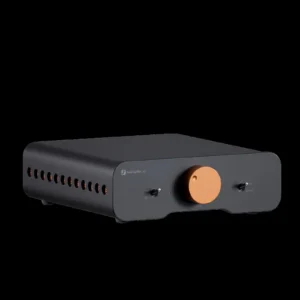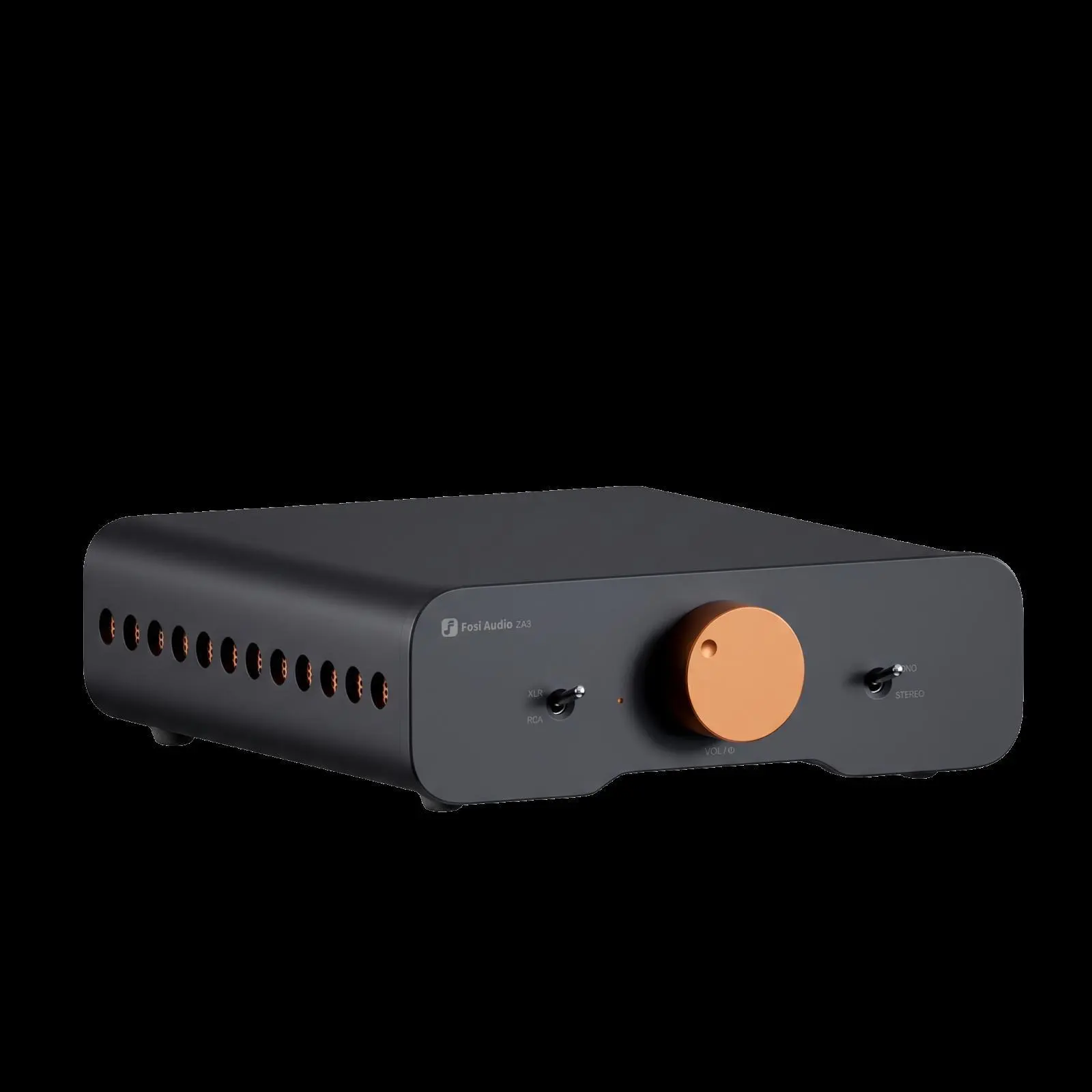
Strip a music system down to its essentials and you find three things: a source that plays the music, a pair of speakers, and a box between them that gives the music enough strength to fill a room. That box, in its purest form, is a 2 channel amplifier — one channel for the left speaker, one for the right, and nothing else competing for its attention.
The ‘2’ is not a limitation or a budget compromise. It is a description of stereo itself, the format nearly all music has been recorded in for over half a century. Two channels carry the entire soundstage: the placement of instruments left to right, the sense of a room, the singer standing in front of the band. A 2 channel amplifier exists to serve that format with full focus, rather than splitting its budget and circuitry across seven or nine channels most music will never use.
Left, Right, and Nothing Else
Stereo works because your two ears hear slightly different things, and recordings are made to exploit that. The left channel holds what the mix places on the left; the right mirrors it. When both speakers are driven evenly and precisely, your brain assembles the phantom centre — the vocalist who sounds present in the room despite no speaker existing where she appears to stand.
That illusion is delicate, and it is why channel matching matters. If one side is slightly louder or lazier than the other, the image smears and wanders. A dedicated stereo amplifier’s whole design brief — shared power supply, matched circuitry, one volume control governing both channels — exists to keep left and right in lockstep.
What the Amplifier Actually Does
A source like a phone, streamer, or turntable preamp delivers a feeble line-level signal, far too weak to move speaker cones. The amplifier’s job is to raise that signal’s power — voltage and current together — to the level speakers demand, while adding nothing of its own: no hum, no distortion, no tonal tilt. In theory it is a straight wire with muscle. In practice, doing that cleanly under wildly changing musical loads is the entire engineering challenge, and it is what separates amplifiers that merely get loud from ones that stay composed.
Where It Sits in a Simple System
The typical chain reads: source → amplifier → speakers. A streamer or CD player feeds the amp’s input; speaker wire carries the amplified signal out. In a setup built around a 2 channel amplifier, that amp is the control centre as well as the muscle — it selects the input, sets the volume, and drives the speakers. Some designs integrate digital conversion too, accepting USB or optical feeds directly, which keeps the whole system to three boxes including the speakers.
Who This Approach Suits
- Music-first listeners whose viewing happens on a TV across the room, not through the hi-fi.
- Anyone building a first real stereo in a bedroom, study, or living room, where two good speakers beat five mediocre ones.
- Vinyl and streaming listeners who value a short, simple signal path over a features list.
Two Channels, Carefully Driven
It is worth pausing on why fewer channels can mean better sound for the same money. A power supply is the heart of any amplifier, and in a stereo design that heart serves exactly two channels. Nothing is shared with centre speakers, height effects, or video boards waiting in standby. When a bass-heavy passage demands current, the whole reservoir answers one call. That focus — the entire engineering budget pointed at a single task — is the quiet advantage behind the format’s reputation.
The format also ages gracefully. A stereo recording from 1965 and one from this year ask exactly the same thing of the equipment, which is why well-kept stereo amplifiers from decades ago still anchor serious systems today. There is no decoding chip to fall out of favour, no format war to lose. The job description was finished long ago: take two channels and do them justice.
None of this requires a dedicated listening room. The same principles hold on a desk with nearfield speakers, in a bedroom, or in a family living room where the system doubles for the television’s evening duties through an auxiliary input. Scale changes; the architecture — source, amplifier, two speakers — stays identical, and so does the pleasure of a soundstage that hangs together. Keep the box ventilated and the cables short and tidy, and the simplest system in the house becomes the one nobody ever has to think about, which is its own kind of luxury.
Home cinema is a different brief, and surround formats genuinely need more channels. But for music — the stereo catalogue of the last sixty years — a 2 channel amplifier is not the stripped-down option. It is the format’s native amplifier, and everything else is an adaptation.
Also Read
- ANR Meaning: Every Definition Explained Clearly (Slang, Tech, Aviation & More)
- Practical HVAC Maintenance Tips to Save Energy and Prevent Unexpected Repairs
- IKR Meaning in Text: The Complete Guide to “I Know, Right?”