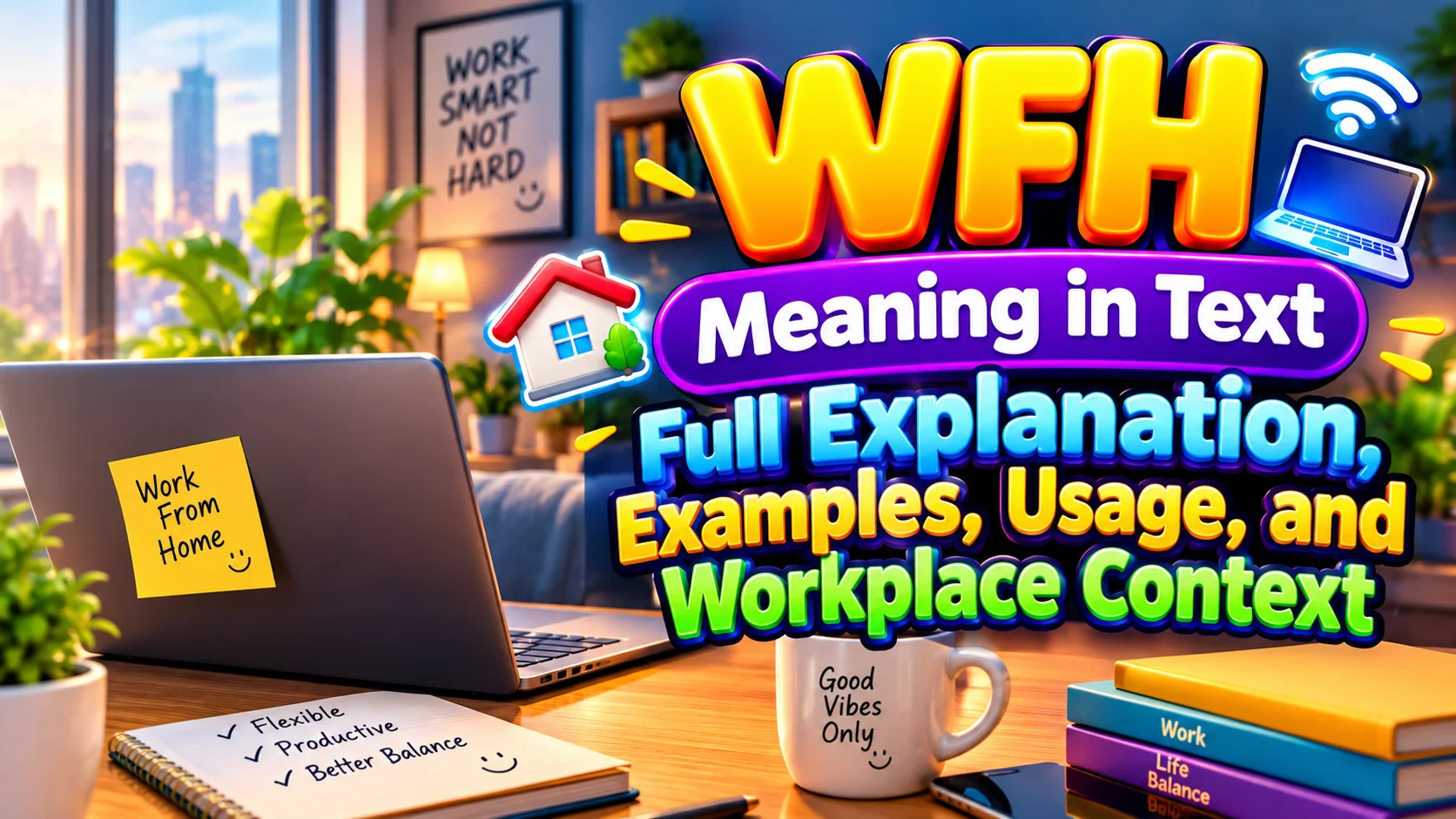
If someone texts you “I’m WFH today,” they probably aren’t using a mysterious piece of internet slang. WFH means “work from home.” It tells you that someone is doing their job from their home instead of traveling to a traditional office or workplace.
You’ll see WFH in text messages, Slack chats, Microsoft Teams conversations, emails, calendars, social media posts, and workplace announcements. It can describe a single day at home, a regular schedule, or a broader work arrangement.
The abbreviation became especially common as remote and flexible work became more widespread. Today, it has become a familiar part of workplace vocabulary. Still, WFH doesn’t always mean exactly the same thing as remote work or hybrid work, which can cause confusion when these terms appear together.
Quick Answer: What Does WFH Mean in Text?
WFH means “work from home.” In a text message, it usually means that a person is working from their home rather than going into an office.
For example:
“I’m WFH today, but I’ll be online all day.”
This means:
“I’m working from home today, but I’ll be available online all day.”
The abbreviation is common in both casual and professional communication. Its meaning usually stays the same regardless of where you see it.
What Does WFH Stand For?
WFH = Work From Home
The three letters represent:
- W = Work
- F = From
- H = Home
Unlike many internet abbreviations that express emotions or reactions, WFH describes a work location or working arrangement.
Is WFH Slang?
Not exactly. WFH is better described as a workplace abbreviation or acronym-like initialism.
People use it casually in texts, but you’ll also find it in professional settings. A manager might write:
“The team will be WFH on Friday.”
An employee might send:
“I’m WFH today because I have a delivery coming.”
So, while it feels informal in a text, the abbreviation itself has a practical workplace function.
Comparison Overview: WFH Meaning in Text vs. Related Terms
The easiest way to understand WFH meaning in text is to compare it with other work-related terms.
| Term | Meaning | Main Idea |
| WFH | Work From Home | Working from your home |
| Remote work | Working away from a traditional office | Location can vary |
| Hybrid work | Combination of remote and office work | Some days remote, some days on-site |
| WFO | Work From Office | Working at the office |
| On-site | Working at the designated workplace | Physically present at the workplace |
| OOO | Out of Office | Not available for normal work duties or away from the workplace |
The distinction matters.
For example, someone can be a remote worker who works from a coworking space, while someone saying “I’m WFH” specifically indicates that they’re working from home.
Main Differences Between WFH Meaning in Text and Remote Work
Although people sometimes use WFH and remote work interchangeably, they aren’t always identical.
WFH focuses on the home. Remote work focuses on working away from the employer’s traditional workplace.
Consider these examples:
- “I’m WFH today.” → The person is working from home.
- “I work remotely.” → The person works away from a traditional office, potentially from home or another location.
- “I have a hybrid schedule.” → The person works remotely on some days and at an office on others.
That small difference becomes important when discussing employment policies.
For example, a company could have a policy allowing employees to work remotely from approved locations. That doesn’t necessarily mean employees can work from anywhere they want.
WFH Meaning in Text Messages
In everyday texting, WFH usually works as a quick status update.
Someone might send:
“WFH today.”
That’s enough information for a coworker who already understands the context. There’s no need to write the entire phrase.
You might also see:
“Are you WFH tomorrow?”
This means:
“Are you working from home tomorrow?”
Another example:
“I’ll be WFH until Friday.”
The person means they’ll work from home through that period.
Common WFH Text Examples
| Text | What It Means |
| “I’m WFH today.” | I’m working from home today. |
| “Are you WFH?” | Are you working from home? |
| “WFH tomorrow?” | Are you working from home tomorrow? |
| “I’ll be WFH Friday.” | I’ll work from home on Friday. |
| “She’s WFH this week.” | She’s working from home this week. |
| “WFH until Monday.” | I’ll continue working from home until Monday. |
| “I prefer WFH.” | I prefer working from home. |
| “WFH makes my commute easier.” | Working from home makes commuting easier. |
Notice something important: the abbreviation doesn’t change the underlying meaning. What changes is the context around it.
WFH Meaning in Casual Conversations
WFH isn’t limited to conversations between managers and employees.
Friends, partners, family members, and coworkers can all use it.
For example:
“Want to grab coffee at noon? I’m WFH today.”
Here, WFH simply explains why the person is nearby or has more flexibility than usual.
Another person might say:
“Can’t meet at the office. I’m WFH.”
In this situation, WFH gives a quick explanation without requiring a longer sentence.
The abbreviation works because the meaning has become familiar to many people.
WFH Meaning in Professional Communication
In workplace communication, WFH often provides a quick location update.
An employee might tell their team:
“I’ll be WFH tomorrow. I’m still available on Teams and email.”
That message communicates two useful facts:
- The employee won’t be physically present at the office.
- The employee remains available for work.
A manager could also write:
“Our team will be WFH on Friday.”
In this case, WFH describes the team’s working arrangement for that day.
WFH in Slack and Microsoft Teams
Workplace chat tools often encourage short messages. That’s one reason abbreviations such as WFH, OOO, EOD, and PTO appear frequently.
Examples include:
- “WFH today. Ping me if you need anything.”
- “I’m WFH until Thursday.”
- “Anyone else WFH tomorrow?”
- “I’ll be WFH but joining the meeting remotely.”
- “WFH this morning, office this afternoon.”
These messages are short because workplace communication often values speed and clarity.
WFH Meaning in Emails
WFH can also appear in professional emails, particularly internal messages.
For example:
“I’ll be WFH tomorrow and will be available by email and Teams.”
This is perfectly understandable among colleagues who know the abbreviation.
However, the full phrase can work better when communicating with clients, customers, vendors, or people unfamiliar with workplace abbreviations.
Instead of:
“I’m WFH today.”
A more formal external message could say:
“I’m working from home today and remain available by email.”
The choice depends on your audience and the formality of the communication.
WFH in Calendar Entries
WFH frequently appears in workplace calendars and status systems.
Someone might add:
- WFH — Monday
- WFH — Tuesday
- WFH AM
- WFH PM
- WFH: Available Online
These labels let coworkers quickly see someone’s work location without opening a detailed message.
A calendar entry such as “WFH — 9 AM–5 PM” generally indicates that the person is working from home during those hours.
WFH Meaning in Social Media Posts
Social media users also use WFH when talking about their daily routines.
For example:
“Finally upgraded my WFH setup.”
Or:
“WFH with a view beats my old commute.”
Here, the abbreviation isn’t necessarily communicating an official workplace status. Instead, it can describe someone’s home-based working lifestyle.
People might use WFH alongside topics such as:
- Home offices
- Desks and monitors
- Remote meetings
- Productivity
- Daily routines
- Coffee and work setups
- Work-life balance
- Flexible schedules
The tone tends to be more casual than workplace communication.
How WFH Is Used at Work
The phrase work from home can describe several different situations. The context tells you which one applies.
WFH as a One-Day Work Arrangement
Sometimes WFH refers to a single day.
For example:
“I’m WFH today because my car is at the shop.”
The employee normally works in an office but is working from home for that particular day.
Other reasons might include:
- A home appointment
- Severe weather
- A temporary office closure
- Personal scheduling needs
- A company’s flexible-work policy
- A short-term change in circumstances
The key point is that WFH doesn’t automatically mean someone permanently works remotely.
WFH as a Regular Schedule
WFH can also describe a recurring arrangement.
For example:
“I WFH every Tuesday and Thursday.”
This person has a regular schedule that includes working from home.
Another example:
“My company lets me WFH three days a week.”
That suggests a recurring flexible or hybrid arrangement.
WFH as a Permanent Arrangement
Some jobs allow employees to work from home as their normal arrangement.
Someone might say:
“I’ve been WFH full-time since joining the company.”
In this context, WFH isn’t a temporary status. It’s part of how the person’s job operates.
Still, WFH policies differ from one employer to another. Some organizations may require employees to live within a certain geographic area, attend occasional meetings, or work from approved locations.
WFH vs. Hybrid Work
Hybrid work combines remote work with time at a workplace.
For example:
“I’m hybrid. I’m in the office Monday through Wednesday and WFH Thursday and Friday.”
Here, WFH represents only one part of the person’s broader work schedule.
A useful way to visualize it is:
Hybrid schedule → Office days + WFH days
So if someone says they’re WFH today, that doesn’t tell you whether they’re a fully remote employee or a hybrid employee.
You need more context.
WFH vs. Remote Work
This distinction causes plenty of confusion.
WFH
WFH specifically means working from home.
Example:
“I’m WFH today.”
Remote Work
Remote work generally means working away from the employer’s normal physical workplace.
A remote employee might work:
- From home
- From a coworking space
- From another approved location
Therefore, WFH is a type of remote work, but the terms aren’t perfect synonyms in every context.
Think of it this way:
Remote work is the larger umbrella. WFH is one specific place underneath it.
WFH vs. WFO
Another abbreviation you’ll encounter is WFO, which commonly means “work from office.”
| Abbreviation | Meaning |
| WFH | Work From Home |
| WFO | Work From Office |
For example:
“I’m WFH Monday and WFO Tuesday.”
That means the person works from home Monday and from the office Tuesday.
These abbreviations can make workplace calendars much easier to scan.
Other Workplace Abbreviations Related to WFH
WFH often appears alongside other short forms.
OOO — Out of Office
OOO generally means someone is unavailable or away from normal work duties.
Example:
“I’m OOO until Monday.”
This differs from WFH.
Someone who is WFH is still working. Someone who is OOO may not be working or available.
Also Read This: GLHF Meaning in Text: Complete Guide With Examples
PTO — Paid Time Off
PTO refers to paid time away from work.
Example:
“I’m taking PTO Friday.”
Again, this isn’t the same as WFH. A person working from home remains on duty.
EOD — End of Day
EOD means end of day.
Example:
“Please send the report by EOD.”
WIP — Work in Progress
WIP means something is currently being worked on but isn’t finished.
Example:
“The presentation is still WIP.”
Understanding these abbreviations helps you interpret workplace messages without having to decode every sentence.
How to Use WFH Correctly in a Sentence
Using WFH is straightforward. Most people place it where they would naturally use the full phrase.
As a Status
“I’m WFH today.”
As a Question
“Are you WFH tomorrow?”
With a Time Period
“I’ll be WFH this week.”
With a Reason
“I’m WFH today because I have an appointment.”
With Availability
“I’m WFH but available on Slack.”
With a Hybrid Schedule
“I WFH Mondays and Fridays.”
These constructions are natural because WFH functions as a compact substitute for “work from home.”
Is WFH Appropriate for Professional Communication?
Yes, WFH can be professional, especially in internal communication.
There’s no inherent lack of professionalism in using an established workplace abbreviation. However, audience matters.
WFH Usually Works Well For
- Internal team chats
- Slack messages
- Microsoft Teams
- Internal emails
- Calendar statuses
- Workplace scheduling
- Informal business communication
Spell Out “Work From Home” When
- Writing for a general audience
- Creating formal documentation
- Communicating with unfamiliar clients
- Writing public-facing content
- Introducing the term for the first time
For example, a company policy might initially say:
Work From Home (WFH)
After defining it, the document can use WFH throughout.
That’s a simple way to keep the writing clear without repeating the full phrase dozens of times.
WFH Capitalization: WFH or wfh?
The standard professional form is WFH.
You’ll commonly see:
- WFH — standard uppercase form
- wfh — informal lowercase form
For example:
“I’m WFH today.”
is more polished than:
“im wfh today”
in professional communication.
That doesn’t mean lowercase usage changes the meaning. It simply reflects a more casual writing style.
Real-Life WFH Conversation Examples
Seeing WFH in complete conversations makes the meaning easier to recognize.
Example: Coworkers
Alex: “Are you in the office today?”
Jordan: “No, I’m WFH today.”
Alex: “Got it. I’ll send the files through Teams.”
Here, WFH simply tells Alex that Jordan isn’t physically at the office.
Example: Scheduling
Sam: “Can we meet for lunch tomorrow?”
Taylor: “I’m WFH tomorrow. Want to meet somewhere near my place?”
The abbreviation explains why Taylor suggests a different meeting location.
Example: Team Communication
“Reminder: The office is closed Friday, so everyone will be WFH. The morning meeting will still happen online.”
Here, WFH describes the temporary working arrangement for the team.
A Simple Case Study: Understanding WFH From Context
Imagine receiving this message from a coworker:
“I’ll be WFH Wednesday. Call me if anything urgent comes up.”
What does it tell you?
First, the person will work from home Wednesday.
Second, they’re still working. The message doesn’t indicate vacation or time off.
Third, they remain reachable for urgent matters.
Now compare it with:
“I’ll be OOO Wednesday.”
That means something quite different. OOO generally indicates that the person won’t be available for their normal work responsibilities.
This simple comparison shows why understanding workplace abbreviations requires attention to context rather than just the letters themselves.
Common Mistakes When Interpreting WFH
Although WFH has a simple definition, people sometimes misunderstand what it implies.
Mistake 1: Assuming WFH Means Someone Isn’t Working
WFH doesn’t mean a person has the day off.
Working from home is still working.
Someone may attend meetings, answer messages, complete projects, and follow their normal schedule from home.
Mistake 2: Treating WFH as Exactly the Same as Remote Work
The terms overlap, but they’re not always identical.
WFH specifically identifies home as the work location.
Remote work describes working away from a traditional workplace more broadly.
Mistake 3: Assuming WFH Means Flexible Hours
WFH describes where someone works, not necessarily when they work.
Someone can work from home from 9 a.m. to 5 p.m. under the same schedule they would follow in an office.
Mistake 4: Assuming WFH Is Always Permanent
A message saying:
“I’m WFH today.”
doesn’t tell you whether the arrangement lasts one day or several years.
You need additional context.
Benefits and Challenges Commonly Associated With WFH
The meaning of WFH is simple, but the arrangement itself can affect how people work.
Common Benefits
- Less commuting: Employees can eliminate or reduce travel to the workplace.
- Location convenience: Work happens from a familiar home environment.
- Potential flexibility: Some employers offer greater scheduling flexibility alongside WFH.
- Home-based comfort: Employees may have more control over their workspace.
- Time savings: Removing a daily commute can free up time.
Common Challenges
- Work-life boundaries: Home and work can begin to blur.
- Communication gaps: Remote conversations may require more deliberate coordination.
- Distractions: Household responsibilities can interrupt the workday.
- Isolation: Some people miss spontaneous face-to-face interaction.
- Workspace limitations: Not everyone has a quiet or dedicated home office.
These factors don’t change the definition of WFH. They explain why companies and employees may have different views about working from home.
WFH in Job Listings
Job seekers may encounter WFH in descriptions of employment arrangements.
For example:
“This position offers three WFH days per week.”
That usually means employees can work from home on three scheduled or approved days.
You might also see language such as:
- WFH available
- WFH option
- WFH flexibility
- WFH two days per week
- WFH after onboarding
However, don’t assume these phrases all mean the same thing. The employer’s actual remote-work policy determines the details.
A job listing that says “remote” may provide more location flexibility than one that says “hybrid with WFH options.”
Why WFH Became Such a Common Expression
The abbreviation gained broad visibility as working from home became a major part of modern workplace communication.
Before digital collaboration tools became widespread, saying someone was working from home often required the full phrase. As remote communication expanded, short workplace terms became more useful.
The logic is simple:
“I’m working from home today.”
becomes:
“I’m WFH today.”
Three letters can replace a five-word phrase without losing the basic meaning.
FAQs:
What does WFH mean in text?
WFH means “work from home.” People use it in texts, workplace chats, emails, and social media to say they’re working from their home rather than their usual office.
What does “I’m WFH today” mean?
It means “I’m working from home today.” The person is still working but won’t be physically present at their normal workplace.
Is WFH the same as remote work?
Not necessarily. WFH specifically means working from home, while remote work can happen from different locations outside a traditional office, such as a coworking space.
Can WFH be used in professional communication?
Yes. WFH is widely understood in workplace communication, especially in internal chats, emails, calendars, and team updates. For formal documents or unfamiliar audiences, writing “work from home” can be clearer.
Does WFH mean you have a day off?
No. WFH means the person is working from home, not taking time off. Someone who is off work might instead use terms such as PTO or OOO, depending on the situation.
Conclusion:
WFH simply means “work from home,” but its context can tell you much more. You might see it describing a single workday, a recurring schedule, or a long-term arrangement. It’s especially common in workplace texts, emails, team chats, calendars, and social media.
Remember that WFH isn’t always identical to remote work. WFH specifically points to home as the work location, while remote work covers a broader range of off-site arrangements. Once you know that distinction, messages such as “WFH tomorrow” or “I’m WFH today” become easy to understand.