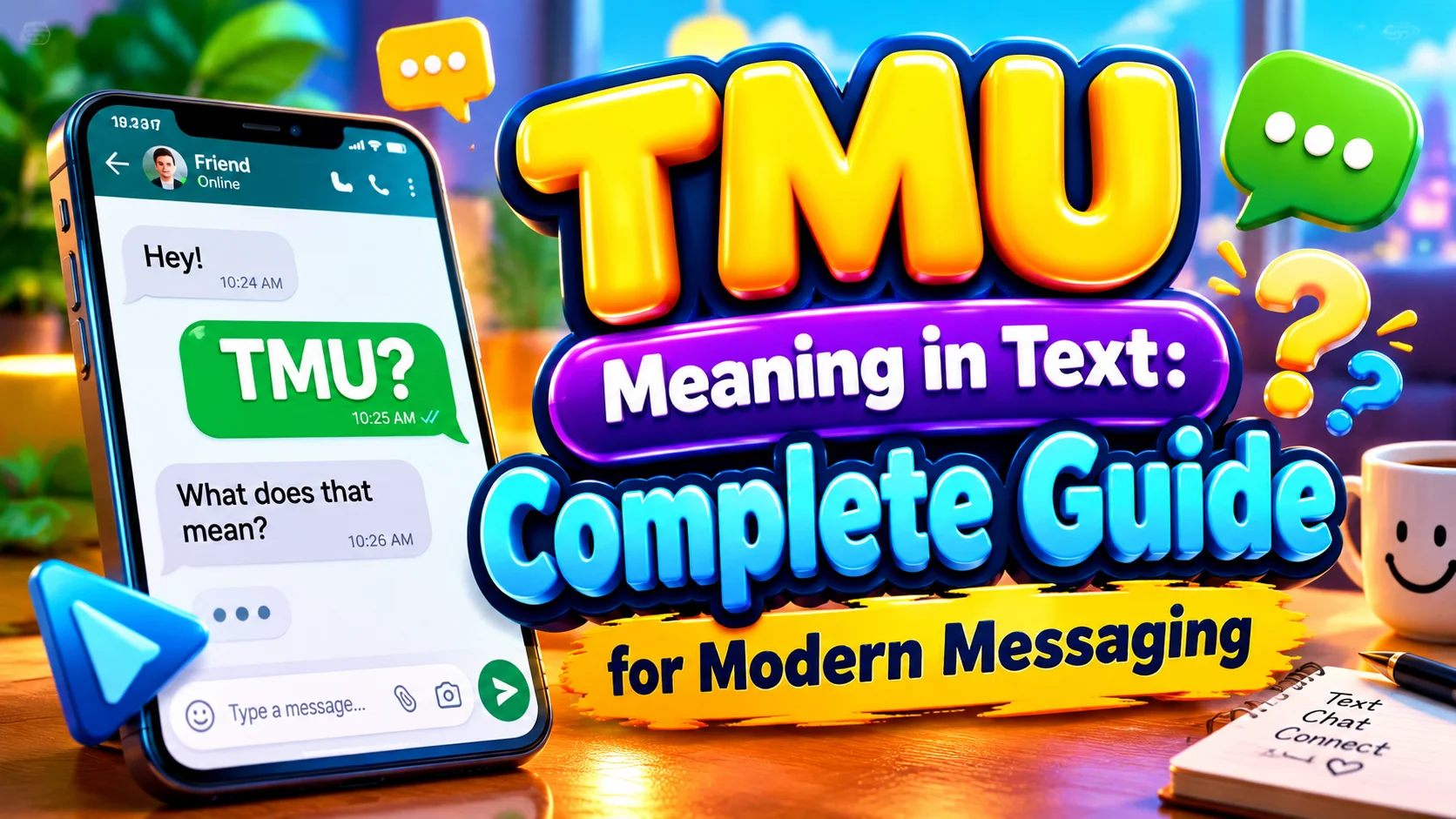
When someone sends “TMU” in a text, you may understand the sentence but still wonder what those three letters actually mean. Texting abbreviations can save time, but they can also create confusion when you don’t know the shorthand.
In most everyday messaging contexts, TMU means “to my understanding.” People use it when they want to explain something based on what they currently understand. It can also soften a statement because the sender isn’t necessarily claiming that their information is unquestionably correct.
For example, someone might text, “TMU, the meeting starts at 10.” In plain English, that means, “To my understanding, the meeting starts at 10.”
However, context matters. TMU isn’t a universal abbreviation with only one possible meaning. A person may use it differently in a particular community, workplace, game, organization, or online conversation. That’s why looking at the surrounding message is important.
This guide explains TMU meaning in text, how people use it, how it differs from similar abbreviations, when you should use it, and how to respond when someone sends it.
Quick Answer: What Does TMU Mean in Text?
TMU usually means “to my understanding” in texting and online messaging.
It tells the reader that the information reflects the sender’s current understanding rather than an absolute statement of fact.
Example
“TMU, the store closes at 9 tonight.”
This means:
“To my understanding, the store closes at 9 tonight.”
The sender may believe the information is correct while leaving room for the possibility that something has changed or that they could be mistaken.
What TMU communicates
When someone uses TMU, they may be doing one or more of these things:
- Sharing information they believe is correct
- Qualifying a statement rather than presenting it as certain
- Clarifying their understanding of a situation
- Avoiding an overly confident claim
- Keeping a casual message short
It works similarly to phrases such as “as I understand it,” “from what I understand,” and “as far as I understand.”
Comparison Overview
The easiest way to understand TMU meaning in text is to compare it with other common abbreviations that express knowledge, uncertainty, or opinion.
| Abbreviation | Meaning | What It Communicates | Typical Tone |
| TMU | To My Understanding | The sender’s understanding of something | Neutral |
| AFAIK | As Far As I Know | Information based on the sender’s knowledge | Neutral |
| IMO | In My Opinion | A personal opinion | Informal |
| IMHO | In My Humble Opinion | A personal opinion, often softened | Informal |
| IIRC | If I Remember Correctly | Uncertain recollection | Casual |
| FWIW | For What It’s Worth | An additional thought or piece of information | Informal |
| TBH | To Be Honest | Signals frankness or directness | Casual |
The important distinction is that TMU focuses on understanding, not necessarily personal preference.
For instance:
- TMU, the deadline is Friday. → This is how I understand the deadline.
- IMO, Friday is too late. → This is my opinion about the deadline.
- AFAIK, the deadline is Friday. → This is what I know about the deadline.
- IIRC, the deadline is Friday. → This is what I remember about the deadline.
Those statements may sound similar, but they don’t carry exactly the same meaning.
Main Differences Between TMU Meaning in Text and Similar Abbreviations
Understanding the difference between TMU and related texting abbreviations can prevent awkward or misleading messages.
TMU vs. AFAIK
TMU means “to my understanding,” while AFAIK means “as far as I know.”
The two can overlap, but their emphasis differs.
Consider:
TMU, the company changed its refund policy.
The sender is talking about how they understand the policy.
Now compare:
AFAIK, the company changed its refund policy.
Here, the sender emphasizes the limits of their knowledge.
In casual conversations, people may use these expressions almost interchangeably. Still, TMU often sounds like the person is interpreting or explaining information they’ve encountered.
TMU vs. IMO
IMO means “in my opinion.”
That’s a personal judgment rather than an explanation of what the sender understands.
TMU, the update comes out tomorrow.
This presents an understanding of a schedule.
IMO, the update isn’t worth installing.
This presents an opinion about the update.
Confusing these meanings can change the message considerably.
TMU vs. IIRC
IIRC means “if I remember correctly.”
This abbreviation specifically signals imperfect memory.
IIRC, the concert starts at 8.
The person is relying on memory.
By contrast:
TMU, the concert starts at 8.
The person is describing their understanding of the information.
One relates more directly to memory, while the other relates to understanding.
TMU vs. TBH
TBH means “to be honest.”
It’s commonly used before a candid opinion or personal reaction.
TBH, I don’t like the new design.
That’s a frank personal response.
TMU doesn’t carry that same emotional or conversational meaning.
What Does “To My Understanding” Actually Mean?
The phrase “to my understanding” tells someone that a statement reflects the information or interpretation currently held by the speaker.
It doesn’t necessarily mean the speaker doubts everything they’re saying. Instead, it creates a small boundary around the claim.
Think of it as saying:
“This is how I understand the situation based on the information I have.”
That distinction matters when information changes quickly.
For example, suppose a friend asks:
“Are we meeting at 7?”
You could answer:
“TMU, yeah. We’re meeting at 7.”
That response suggests 7 is the time you understand to be correct. However, you’re not presenting yourself as the final authority on the schedule.
This makes TMU particularly useful when you’re passing along information you didn’t personally establish.
How TMU Is Used in Text Messages
People generally use TMU at the beginning of a statement. It works much like the full phrase “to my understanding.”
TMU for Clarifying Information
A common use involves answering someone’s question.
“TMU, the appointment is still scheduled for Thursday.”
The sender is giving useful information while making it clear that they’re relying on their understanding.
This can be helpful when the conversation involves schedules, rules, plans, policies, or recent changes.
TMU for Showing Limited Certainty
Sometimes you know something well enough to mention it but not well enough to guarantee it.
“TMU, Sarah already submitted the application.”
The sender isn’t necessarily saying Sarah definitely submitted it. They’re explaining what they believe to be true.
That subtle distinction can prevent a message from sounding unnecessarily absolute.
TMU for Correcting Someone Politely
TMU can also make a correction sound less confrontational.
Compare:
“You’re wrong. The event is Saturday.”
with:
“TMU, the event is actually Saturday.”
The second version leaves room for discussion. It communicates a different level of confidence and often feels less aggressive.
TMU for Sharing Information in Group Chats
Group conversations often involve people working from different pieces of information.
Someone might write:
“TMU, we’re supposed to submit everything by Friday.”
That gives the group a useful reference point without pretending the sender has final authority.
TMU Meaning in Text With Realistic Examples
Examples make the meaning much easier to recognize.
Example 1: Friends Making Plans
Alex: “Are we still going to Mike’s place tonight?”
Jordan: “TMU, yeah. We’re meeting around 7.”
Here, TMU means Jordan believes the plan remains unchanged.
Example 2: School Assignment
“TMU, Professor Lee wants the essay submitted by Monday.”
The student is explaining their understanding of the deadline.
If another student has different information, they can check the course instructions instead of treating the message as unquestionable fact.
Example 3: Workplace Chat
“TMU, the client approved the first draft this morning.”
The abbreviation qualifies the statement. The employee believes that’s what happened based on the information available to them.
In a formal report, however, writing “To my understanding” would usually be clearer.
Example 4: Gaming Conversation
“TMU, the new patch drops tomorrow.”
The gamer believes tomorrow is the release date.
Because game schedules can change, the qualification may be useful.
Example 5: Social Media Discussion
“TMU, that feature only works for verified accounts.”
The writer is presenting their understanding of how the feature works.
Someone reading the comment might still verify the platform’s current rules.
Example 6: Everyday Conversation
“TMU, they’re moving the appointment to next week.”
The speaker isn’t necessarily responsible for the schedule. They’re simply sharing what they understand.
TMU Meaning on Social Media and Online Platforms
The TMU meaning in text doesn’t fundamentally change across social platforms. However, the way people encounter it can vary.
Text Messaging
In private texts, abbreviations tend to be short and casual.
“TMU we’re good for Friday.”
There’s little need for formal wording between people who already understand each other’s communication style.
Discord
Discord communities often rely heavily on shorthand. TMU may appear in gaming discussions, community announcements, or debates.
“TMU, the server resets at midnight.”
The exact meaning still depends on the sentence.
Gaming Communities
Players frequently discuss updates, patches, rules, events, and schedules.
“TMU, the event starts after the reset.”
Here, the abbreviation qualifies information that might depend on a game’s current schedule.
Social Media Comments
On platforms such as Reddit, X, Facebook, or Instagram, people may use abbreviations to keep replies compact.
“TMU, that policy changed last month.”
Because social media discussions often involve incomplete information, readers should pay attention to the surrounding conversation.
Workplace Messaging
Internal chat platforms can sit somewhere between casual and formal communication.
A colleague might write:
“TMU, we’re waiting for legal to approve it.”
That can work in a casual team chat. However, the full phrase may be better when communicating with clients or documenting an important decision.
Is TMU Formal or Informal?
TMU is primarily an informal or semi-casual abbreviation.
It fits naturally into:
- Text messages
- Group chats
- Discord conversations
- Social media
- Casual online discussions
- Informal workplace chats
It’s less suitable for:
- Academic papers
- Formal reports
- Legal documents
- Business proposals
- Official correspondence
- Professional emails to unfamiliar recipients
For formal writing, use the complete phrase:
“To my understanding, the revised policy takes effect on October 1.”
Instead of:
“TMU, the revised policy takes effect on October 1.”
The longer version requires only a few extra words, yet it removes any uncertainty about what the abbreviation means.
Also Read This: WFH Meaning in Text: Full Explanation, Examples, Usage, and Workplace Context
Is TMU Common in Modern Messaging?
Texting language changes quickly. Some abbreviations become widespread while others remain relatively niche.
That’s why it’s risky to describe TMU as universally understood by every English speaker.
A person who spends a lot of time in online communities may recognize it immediately. Another reader may have never encountered it.
Audience matters
Before using TMU, consider:
- Who are you messaging?
- How familiar are they with texting shorthand?
- Is the conversation casual?
- Could misunderstanding cause a problem?
- Would writing the full phrase be just as easy?
When clarity matters more than speed, spell it out.
That’s especially true for professional communication.
Other Possible Meanings of TMU
Although “to my understanding” is a relevant interpretation in messaging, TMU can represent other terms in different settings.
For example, TMU may appear as an institutional abbreviation, an organization name, a university reference, a technical term, or an acronym specific to a particular community.
The context determines which interpretation makes sense.
Consider the difference between these:
“TMU, the deadline is Friday.”
and:
“I graduated from TMU.”
The first sentence can naturally support the “to my understanding” interpretation.
The second sentence likely refers to a named institution or organization.
This is why an abbreviation should never be interpreted in isolation.
How to Tell What TMU Means From Context
If someone sends TMU and you’re unsure what they mean, you don’t need to guess.
Use the surrounding message as your first clue.
Look at the sentence
If TMU introduces a statement about what someone believes, “to my understanding” is a strong interpretation.
“TMU, the store is closed today.”
Look at the conversation topic
A discussion about schedules, rules, policies, or plans makes the texting interpretation more plausible.
A conversation about a university or organization may point toward a different meaning.
Look at the sender
People develop their own shorthand. If someone regularly uses abbreviations, TMU may simply be part of their texting style.
Ask when necessary
There’s nothing wrong with asking:
“What does TMU mean here?”
A quick question is better than building an entire conversation around a wrong assumption.
When Should You Use TMU?
TMU works best when you’re sharing an understanding rather than stating something as unquestionable fact.
Use it when:
- You want to qualify information.
- You’re passing along something you’ve learned.
- You aren’t the final authority on the subject.
- You’re chatting casually.
- The recipient understands common abbreviations.
- You want to keep a message concise.
Example
“TMU, the tickets go on sale Friday.”
This is useful when you believe Friday is correct but don’t want to present the information as an absolute guarantee.
When Should You Avoid TMU?
There are situations where spelling everything out makes more sense.
Avoid the abbreviation when:
- The reader may not understand it.
- You’re writing formally.
- The information has legal or financial consequences.
- You’re documenting an important decision.
- You’re communicating with a customer or unfamiliar professional.
- Precision matters more than brevity.
For example, a contract shouldn’t rely on unexplained texting abbreviations.
Likewise, if you’re emailing a new client, this is safer:
“To my understanding, the revised timeline begins next Monday.”
Clear writing beats clever shorthand when the stakes are high.
Common Mistakes When Using TMU
Even when you know the TMU meaning in text, a few mistakes can make the message unclear.
Treating TMU as Absolute Proof
TMU qualifies your understanding. It doesn’t prove that the information is correct.
If you write:
“TMU, the flight leaves at 6.”
You should still check the airline’s current schedule if the flight matters.
Using TMU for an Opinion
Don’t use TMU when you really mean “in my opinion.”
Incorrect use:
“TMU, this movie is boring.”
If you’re expressing your personal judgment, IMO or plain language works better.
A better version would be:
“IMO, this movie is boring.”
Assuming Everyone Knows the Abbreviation
Not every reader follows the same online language.
A coworker, teacher, older relative, or new contact may understand the full phrase more easily.
Using Too Many Abbreviations
A message like this can quickly become exhausting:
“TMU, AFAIK, IIRC the ETA is EOD, TBH.”
Even if every abbreviation is technically correct, the reader has to decode the sentence before understanding it.
Plain English usually wins.
Case Study: Why the Difference Between TMU and AFAIK Matters
Imagine a coworker asks:
“Did the manager approve the new schedule?”
You respond:
“TMU, yes. She approved it yesterday.”
You’re describing your understanding of the situation.
Now imagine you respond:
“AFAIK, yes.”
You’re emphasizing that, as far as your knowledge extends, the answer is yes.
The distinction is subtle, but it becomes important when information comes from different sources.
If you personally saw the approval, you could make a stronger statement.
If you heard about it from another employee, qualifying the claim makes more sense.
Good messaging doesn’t just transmit information. It communicates how confidently the sender holds that information.
How to Respond to “TMU” in a Text
Your response should depend on whether you agree with the information.
If You Agree
“Yeah, that’s my understanding too.”
If You’re Not Sure
“That’s what I thought, but I’ll check.”
If You Have Different Information
“I thought they changed that yesterday. Let me confirm.”
If You Know the Sender Is Mistaken
“I think that’s outdated. The latest announcement says Friday.”
If You Don’t Know What TMU Means
“What do you mean by TMU?”
There’s no need to overthink it. A short clarification can resolve the issue immediately.
TMU Meaning in Text: Quick Examples by Context
| Context | Example | Meaning |
| Friends | “TMU, we’re meeting at 7.” | That’s how I understand the plan. |
| School | “TMU, the paper is due Monday.” | That’s my understanding of the deadline. |
| Work | “TMU, the client approved it.” | That’s what I understand happened. |
| Gaming | “TMU, the patch drops tomorrow.” | That’s my understanding of the release date. |
| Social media | “TMU, the rule changed recently.” | That’s how I understand the current rule. |
| Group chat | “TMU, everyone needs to register.” | That’s my understanding of the requirement. |
FAQs:
What does TMU mean in text?
TMU usually means “to my understanding.” People use it in texts and online chats when they want to share how they understand a situation without presenting their statement as absolute fact.
What does TMU stand for?
In casual messaging, TMU stands for “to my understanding.” It works as a shortened version of the full phrase and can make conversations quicker and more casual.
Is TMU the same as AFAIK?
Not exactly. TMU means “to my understanding,” while AFAIK means “as far as I know.” TMU focuses on someone’s understanding of information, whereas AFAIK emphasizes the limits of their knowledge.
Is TMU appropriate for professional communication?
TMU can work in casual workplace chats, especially when colleagues commonly use abbreviations. However, spelling out “to my understanding” is usually better for formal emails, reports, documents, and client communication.
Can TMU have other meanings?
Yes. TMU can represent different words or names depending on the context. If the surrounding conversation doesn’t relate to someone’s understanding, check the topic or ask the sender what they mean rather than assuming.
Conclusion:
TMU usually means “to my understanding” in text messages and online conversations. It helps you share information while making it clear that you’re speaking from your current understanding.
The abbreviation is particularly useful for discussing plans, deadlines, rules, updates, and information that could change. Still, context matters. When you’re communicating formally or with someone unfamiliar with texting shorthand, writing the complete phrase is the clearer choice.
If you remember one thing, remember this: TMU signals understanding, not absolute certainty.