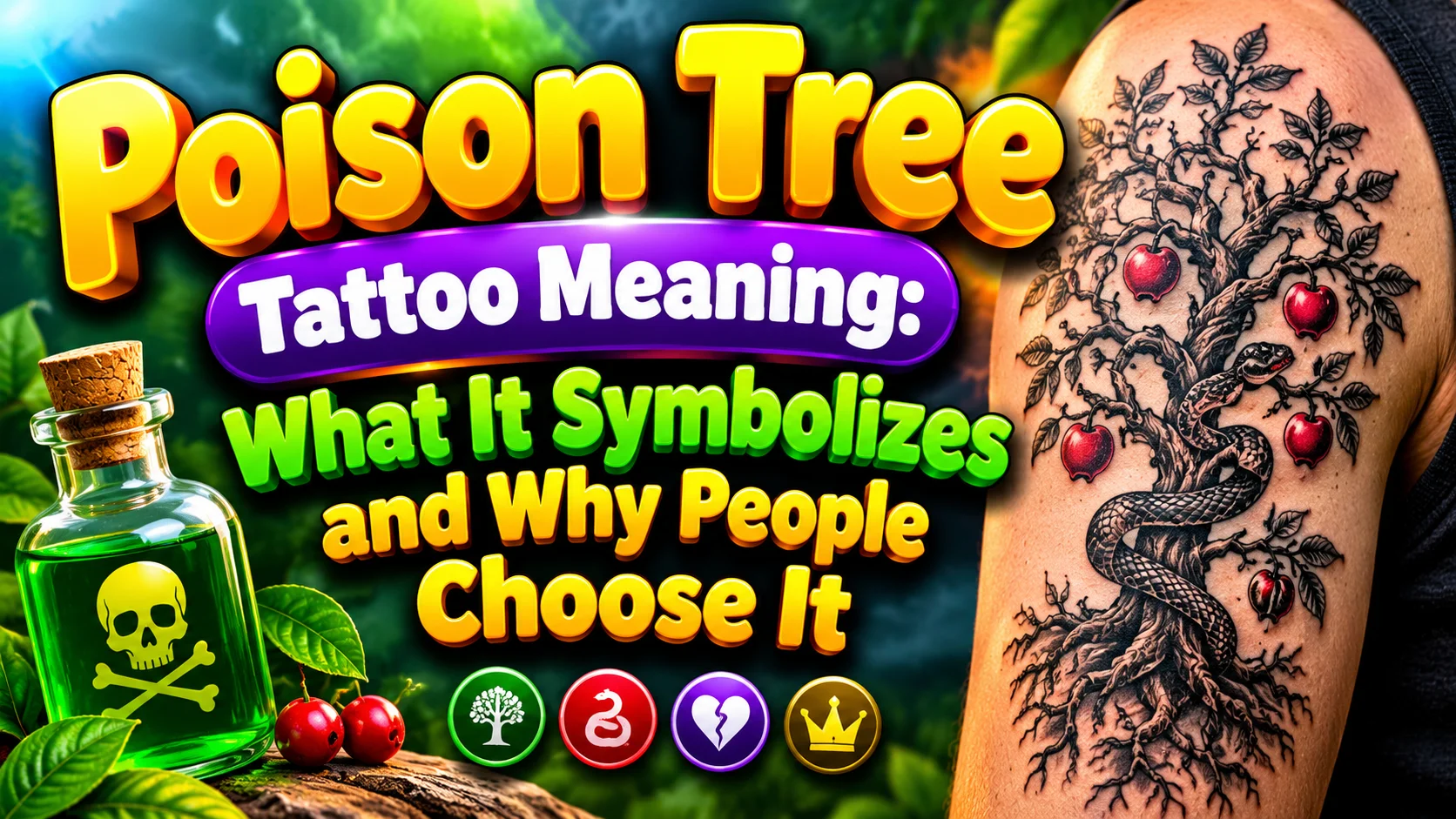
A tree tattoo usually brings peaceful images to mind: strong roots, fresh leaves, family connections, growth, and new beginnings. A poison tree tattoo takes that familiar image in a much darker direction. Its twisted branches, exposed roots, thorns, and poisonous fruit can tell a story about anger, resentment, betrayal, temptation, or emotional survival.
The meaning becomes especially interesting when the tattoo connects to William Blake’s famous poem “A Poison Tree.” Published in Songs of Experience in 1794, the poem describes anger that grows when a person hides it rather than addressing it. Blake turns that emotion into a tree that eventually produces poisonous fruit.
That literary connection gives the design unusual depth. However, you don’t need to be a Blake scholar to choose this tattoo. Someone might use a poison tree to represent a toxic relationship, a painful chapter, a warning about resentment, or personal growth after hardship.
In other words, the poison tree tattoo meaning depends heavily on the design and the story behind it.
Quick Answer: What Does a Poison Tree Tattoo Mean?
A poison tree tattoo commonly symbolizes suppressed anger, resentment, betrayal, emotional pain, toxicity, temptation, and the consequences of allowing negative feelings to grow.
Its strongest literary association comes from William Blake’s 1794 poem “A Poison Tree.” In the poem, hidden anger toward an enemy grows into a tree that produces poisonous fruit.
However, the tattoo doesn’t have one universal definition. For one person, it may represent revenge or bitterness. For another, it may serve as a reminder to let go of anger. A tree with dead branches and fresh leaves might even symbolize healing after a destructive period.
The surrounding imagery matters. Roots, fruit, snakes, flowers, broken branches, and sunlight can all change the message.
Comparison Overview
A poison tree tattoo sits somewhere between traditional tree symbolism and darker forms of botanical tattoo art. Comparing these ideas makes its meaning easier to understand.
| Symbol or Design | Common Meaning | Emotional Tone |
| Healthy tree | Life, strength, family, growth | Positive |
| Poison tree | Resentment, toxicity, consequences | Dark or reflective |
| Dead tree | Loss, grief, endings | Somber |
| Tree with new leaves | Recovery, renewal, transformation | Hopeful |
| Poisonous fruit | Temptation, danger, consequences | Mysterious |
| Exposed roots | Past experiences, hidden emotions | Introspective |
| Twisted branches | Conflict, complicated emotions | Dark |
| Tree with thorns | Pain, protection, boundaries | Defensive |
| Tree with a snake | Deception, temptation, betrayal | Symbolic and dramatic |
| Tree with flowers | Healing, beauty after hardship | Hopeful |
The important point is that these interpretations aren’t strict tattoo rules. Tattoo symbolism has no universal dictionary. Personal experience often matters more than traditional interpretations.
Main Differences Between Poison Tree Tattoo Meaning
The poison tree tattoo meaning can change significantly depending on whether the wearer focuses on the literary origin, personal experience, or visual style.
A Blake-inspired tattoo often centers on anger and resentment. A gothic poison tree may focus more heavily on darkness, mortality, or mystery. Meanwhile, a half-dead and half-living tree can represent recovery.
Here are the main differences:
| Interpretation | What It Represents | Typical Design |
| Literary | Hidden anger and resentment | Twisted tree with poisonous fruit |
| Emotional | Unresolved pain | Deep roots and damaged branches |
| Relationship | Betrayal or toxicity | Broken branches, thorns, dark fruit |
| Psychological | Inner conflict | Dense roots and distorted branches |
| Transformational | Healing after hardship | Dead branches with fresh growth |
| Warning | Consequences of negative emotions | Poisonous fruit and dark shading |
| Aesthetic | Gothic or mysterious beauty | Black-and-gray botanical design |
| Personal | A specific life experience | Custom symbols and meaningful details |
This flexibility explains why two people can wear nearly identical poison tree tattoos while carrying completely different meanings.
What Is a Poison Tree Tattoo?
A poison tree tattoo depicts a tree associated with danger, toxicity, emotional darkness, or destructive growth. Unlike a traditional tree-of-life tattoo, the design usually contains visual clues that suggest something is wrong beneath the surface.
The tree might look twisted or diseased. Its roots may spread aggressively across the skin. Its branches can appear broken or unusually sharp. Some designs include dark fruit that looks tempting yet dangerous.
The contrast creates the tattoo’s power.
A tree normally represents growth. Poison represents harm. Put them together and you get an image of something harmful that grows over time.
That concept works particularly well for emotions such as resentment. Anger doesn’t always appear suddenly. Sometimes it begins with a small grievance. If someone continually feeds that feeling, it can become much larger.
The tattoo therefore works as a visual metaphor:
A small emotional seed can become something much larger when you continue to nurture it.
The Origin of the Poison Tree Tattoo Meaning
William Blake’s “A Poison Tree”
The most famous literary connection comes from English poet and artist William Blake.
Blake published Songs of Experience in 1794. The collection explores darker aspects of human life, morality, innocence, experience, and social behavior. “A Poison Tree” appears in that collection.
The poem begins with a simple distinction between expressing anger and hiding it. Blake writes:
“I was angry with my friend:
I told my wrath, my wrath did end.”
The poem then contrasts that experience with anger toward an enemy. Instead of expressing the emotion, the speaker hides and cultivates it.
Blake writes:
“I was angry with my foe:
I told it not, my wrath did grow.”
That line explains much of the modern symbolism behind a poison tree tattoo.
The speaker’s anger becomes a growing tree. Eventually, the tree produces an apple that attracts the enemy.
The full poem is available through.
How Blake’s Poem Connects to Tattoo Symbolism
Blake turns an abstract emotion into something physical. That’s exactly what tattoo art does.
A poison tree can visually transform the stages of resentment:
- Seed: A small grievance or painful experience
- Roots: Hidden feelings and unresolved emotions
- Trunk: The emotion becoming stronger over time
- Branches: The emotion spreading into other parts of life
- Fruit: The eventual consequence
- Poison: The destructive result of what has been cultivated
This makes the design more than an attractive piece of dark artwork.
It can become a reminder.
Someone might look at the tattoo years later and remember not only what happened but also what they learned from it.
It’s also important to avoid assuming every poison tree tattoo comes directly from Blake. Many people discover the design independently through gothic art, botanical imagery, fantasy, or personal symbolism.
Poison Tree Tattoo Meaning: Core Symbolism
Suppressed Anger
Suppressed anger is one of the strongest meanings associated with a poison tree tattoo.
This interpretation comes directly from Blake’s poem. The tree represents anger that isn’t resolved but instead receives continued attention.
Imagine watering a plant every day. It grows because you’re feeding it.
Blake applies that basic idea to resentment. The more the speaker nurtures his anger, the larger the symbolic tree becomes.
A tattoo based on this interpretation can serve as a personal warning:
Don’t feed the emotions that can eventually consume you.
Resentment and Bitterness
Resentment often develops quietly. Unlike an immediate argument, it can remain hidden for months or years.
That’s why roots work so well in poison tree imagery.
Roots exist underground. You don’t see most of them. Yet they support everything above the surface.
A tattoo with enormous exposed roots can therefore represent emotional experiences that remain hidden beneath someone’s outward appearance.
The person may look calm while carrying years of unresolved bitterness.
Betrayal and Broken Trust
A poison tree can also symbolize betrayal.
Someone who has experienced broken trust may choose a damaged tree to represent the relationship. Broken branches can show separation. Deep roots can represent how long the relationship affected them.
The symbolism doesn’t necessarily mean hatred toward the person responsible.
Sometimes it means:
“This experience changed me.”
That’s an important distinction. A tattoo can commemorate pain without celebrating revenge.
Revenge and Consequences
The poisonous fruit in Blake’s poem carries a strong connection to revenge and consequences.
The speaker’s enemy ultimately encounters the fruit produced by the speaker’s cultivated anger. The ending is deliberately disturbing because it raises questions about hatred and revenge rather than presenting them as simple victories.
A poison tree tattoo can therefore symbolize the consequences of holding onto anger.
It may represent something like:
What you cultivate eventually produces consequences.
That message can point inward as much as outward.
Toxicity and Emotional Danger
Poison naturally suggests something harmful.
For that reason, the tattoo can represent a toxic person, relationship, friendship, environment, or period of life.
A beautiful tree covered in poisonous fruit creates an especially effective contrast. From a distance, it looks attractive. Up close, something feels wrong.
That mirrors toxic situations surprisingly well.
Not everything dangerous looks dangerous at first.
Pain That Turns Into Growth
A poison tree doesn’t have to remain entirely negative.
Some people deliberately combine dark and living elements. The roots and trunk may look damaged while fresh leaves emerge from the branches.
That design changes the message.
Instead of saying “I am still trapped in this pain,” it can say:
“I survived it and grew beyond it.”
This interpretation makes the tattoo suitable for people who want to acknowledge difficult experiences without allowing those experiences to define their future.
Self-Awareness and Letting Go
Another meaningful interpretation involves emotional awareness.
The tree can represent a lesson about what happens when anger remains unchecked. In that sense, the tattoo becomes less about hatred and more about recognizing destructive patterns.
Someone might choose the image as a reminder to communicate honestly, establish boundaries, forgive when appropriate, or simply stop carrying an old grievance.
The darkest-looking tattoo can sometimes carry the most constructive message.
Poison Tree Tattoo Symbolism by Element
Every part of the tattoo can tell a different part of the story.
| Tattoo Element | Possible Symbolism |
| Roots | Buried memories, unresolved emotions, personal history |
| Trunk | Endurance, time, emotional development |
| Twisted branches | Inner conflict or complicated experiences |
| Poisonous fruit | Consequences, temptation, revenge |
| Thorns | Pain, defense, emotional boundaries |
| Dead branches | Loss, exhaustion, endings |
| Fresh leaves | Recovery, hope, renewal |
| Snake | Temptation, deception, betrayal |
| Broken branches | Separation, damage, broken relationships |
| Light | Hope, clarity, transformation |
| Falling fruit | Consequences or letting go |
| Flowers | Beauty after hardship |
These meanings aren’t universal. Think of them as building blocks.
You can combine several elements to create a tattoo that tells a specific story.
Poison Tree Tattoo Meaning in Relationships
After Betrayal
A poison tree can mark the emotional aftermath of betrayal.
The tree’s damaged appearance can represent the damage caused by broken trust. A single surviving branch might represent the part of the person that continued forward.
This approach feels more personal than simply tattooing a name or date.
Toxic Relationships
Poison imagery fits naturally with toxic relationships.
The tree may symbolize a relationship that initially appeared beautiful but gradually became harmful. Dark fruit can represent the consequences. Thorns can represent boundaries established afterward.
For someone leaving a damaging relationship, the tattoo can become a visual marker of independence.
Moving on From Resentment
Interestingly, the tattoo can represent letting go of resentment rather than keeping it alive.
For example, imagine a tree with blackened roots but bright leaves near the top. The lower section represents the past. The upper section represents the life that followed.
The message becomes clear:
The past may be part of your story without controlling your future.
Popular Poison Tree Tattoo Design Ideas
Blake-Inspired Poison Tree
A Blake-inspired design might feature a gnarled tree with a prominent apple.
This is one of the clearest choices for someone who specifically loves “A Poison Tree.” The apple becomes more than decoration because it connects the tattoo to the poem’s central image.
Adding a small quotation or subtle literary reference can strengthen that connection.
Dark Gothic Poison Tree
Gothic designs typically emphasize atmosphere.
Think:
- Gnarled branches
- Heavy black shading
- Bare limbs
- Sharp roots
- Dark fruit
- Dramatic shadows
- Moonlight or fog
This version can represent emotional darkness while also functioning as a striking piece of gothic art.
Poison Tree With an Apple
The apple deserves special attention because of its literary significance.
In Blake’s poem, the fruit represents the result of cultivated anger. It also carries associations with temptation and danger because of its broader cultural history.
A single apple hanging from an otherwise barren tree can create powerful visual tension.
Poison Tree With a Snake
A snake can introduce another layer of meaning.
Depending on the design, it may suggest:
- Deception
- Temptation
- Betrayal
- Hidden danger
- Transformation
However, the snake isn’t required for a poison tree tattoo. Adding too many symbols can make the design difficult to read.
Dead Tree With New Growth
This may be the best choice for someone who wants a hopeful interpretation.
The lower branches can appear dead while new leaves emerge higher up. Flowers can also grow around damaged roots.
The contrast communicates resilience without pretending the past never happened.
Minimalist Poison Tree
Not every poison tree needs dramatic gothic details.
A fine-line design with a simple tree and one small fruit can carry the same basic concept.
Minimalist tattoos work especially well when the wearer already understands the personal story behind the image.
Half-Dead, Half-Living Tree
This design creates an obvious visual divide.
One side may contain dead branches and dark fruit. The other can show leaves, flowers, or sunlight.
The contrast can symbolize:
- Past vs. present
- Anger vs. peace
- Destruction vs. growth
- Pain vs. healing
- Old identity vs. new identity
Color Meanings in Poison Tree Tattoos
Color can dramatically change the mood of a tattoo.
Black and Gray
Black-and-gray work emphasizes seriousness, mystery, grief, and gothic atmosphere.
It’s also particularly effective for detailed bark, roots, and shadows.
Red Fruit
Red fruit can draw attention immediately.
It may suggest:
- Anger
- Danger
- Passion
- Blood
- Temptation
- Consequences
A single red apple against a mostly monochrome tree creates a strong focal point.
Also Read This: Fyrtrd Meaning: The Complete, Clear Guide Everyone Is Searching For
Green Leaves
Green usually introduces a sense of life and renewal.
Fresh green leaves can therefore soften a dark poison tree and suggest recovery.
Purple or Deep Blue
These colors can create a more surreal or mysterious appearance.
They’re useful when the tattoo leans toward fantasy rather than strictly literary symbolism.
Keep in mind that tattoo colors don’t have fixed meanings. Context determines symbolism. The same red fruit could represent rage for one person and love for another.
Why Do People Choose a Poison Tree Tattoo?
To Represent a Difficult Chapter
Some tattoos act as permanent milestones.
A person may choose a poison tree after surviving a difficult relationship, major disappointment, betrayal, or emotionally challenging period.
The tattoo doesn’t have to explain every detail to outsiders.
Sometimes it only needs to make sense to the person wearing it.
To Remember a Lesson
A poison tree can work like a visual reminder.
Instead of commemorating the painful event itself, the tattoo can represent what the person learned from it.
That makes the design less about the wound and more about wisdom gained afterward.
To Represent Emotional Transformation
Dark imagery can communicate transformation surprisingly well.
A damaged tree that produces fresh growth tells a more nuanced story than a simple symbol of happiness.
It says that healing can happen without erasing the past.
Because They Connect With William Blake
Literary tattoos allow people to carry an idea from a poem, novel, or piece of philosophy into everyday life.
Blake’s “A Poison Tree” is especially suitable because the poem already transforms emotion into a physical object.
That makes it easy to translate into visual art.
For more information about Blake and his work, see the.
Because They Like Dark Botanical Art
Sometimes the reason is much simpler.
A person may simply love botanical tattoos with a darker aesthetic.
Not every tattoo requires a tragic backstory. Some people choose unusual imagery because it looks beautiful, mysterious, or distinctive.
That’s perfectly valid.
Is a Poison Tree Tattoo Always Negative?
No.
This is one of the biggest misconceptions surrounding the design.
A poison tree can symbolize something negative, but it can also represent awareness, survival, growth, and change.
Consider these different messages:
- Anger: “I know what unresolved anger can become.”
- Betrayal: “This experience changed me.”
- Toxicity: “I recognize what harms me.”
- Healing: “I grew beyond something destructive.”
- Self-awareness: “I won’t repeat the same pattern.”
- Growth: “Something new came from a difficult experience.”
The visual style can reinforce the intended message.
A completely dead tree feels mournful. A tree with new leaves feels hopeful. A tree surrounded by flowers feels transformative.
The symbolism is in the details.
Is the Poison Tree Tattoo Connected to Religion or Mythology?
William Blake and Biblical Imagery
Blake’s poem can evoke biblical imagery because of its use of an apple and the idea of temptation.
However, it’s important not to describe a poison tree as a formal biblical symbol.
The biblical Tree of Knowledge of Good and Evil appears in Genesis. Blake’s poem isn’t simply a retelling of that story.
Instead, Blake uses familiar ideas about fruit, temptation, knowledge, and wrongdoing to build his own metaphor.
That distinction matters when explaining the tattoo’s origin.
Mythological Interpretations
Dangerous plants and poisonous fruits appear across different myths and folklore traditions.
However, there isn’t one ancient myth that universally defines the modern poison tree tattoo.
If a tattoo uses a specific mythological tree, its meaning should come from that particular tradition rather than being labeled simply as a “poison tree.”
Spiritual Interpretations
Some people may give the tattoo a spiritual meaning involving:
- Moral consequences
- Inner conflict
- Transformation
- Temptation
- Releasing harmful emotions
- Learning from past mistakes
These are personal interpretations rather than fixed religious definitions.
Best Placements for a Poison Tree Tattoo
Forearm
The forearm provides a naturally vertical canvas.
It’s particularly suitable for a tree with long roots and spreading branches.
Upper Arm
The upper arm allows more room for detail.
It’s a good choice for designs featuring fruit, snakes, flowers, or elaborate roots.
Back
The back offers one of the largest canvases on the body.
A large poison tree can spread its branches across the shoulder blades while the roots extend downward.
Chest
A chest tattoo can make the symbolism feel especially personal.
It also gives artists enough room to create a detailed composition.
Calf or Thigh
These areas work well for tall tree designs.
They also offer flexibility if you want a medium or large tattoo.
Wrist or Ankle
Smaller placements suit minimalist poison tree designs.
Fine details may become difficult at very small sizes, though. An experienced tattoo artist can simplify the artwork without losing its core symbolism.
Questions to Ask Before Getting a Poison Tree Tattoo
Before making the design permanent, ask yourself:
- What exactly does the tree represent to me?
- Is the tattoo inspired by William Blake?
- Does the fruit represent temptation, anger, or something personal?
- Should the tree look dead or alive?
- Do the roots have a specific meaning?
- Do I want the tattoo to feel dark or hopeful?
- Would flowers or new leaves better represent my story?
- Do I want the symbolism to be obvious to other people?
- Will I still connect with the meaning several years from now?
- Does the tattoo artist have experience with botanical or illustrative work?
These questions can turn a generic concept into a meaningful custom design.
How to Make the Poison Tree Tattoo Meaning More Personal
The strongest tattoos often contain small details that outsiders might overlook.
For example, you could incorporate a meaningful date into the roots. A specific flower might represent someone important. One broken branch could symbolize a relationship that ended.
You can also use the fruit to tell part of the story.
Perhaps there is one poisonous apple among healthy leaves. That could represent one painful experience surrounded by an otherwise fulfilling life.
Another option is to show the tree changing from bottom to top.
The roots remain dark. The trunk carries scars. The branches become healthier. Fresh leaves appear at the top.
That’s a visual story of recovery.
A Simple Personalization Formula
Past experience + emotional meaning + visual symbol = personal tattoo story
For example:
Betrayal + healing + broken tree with new leaves = survival and growth
Or:
Suppressed anger + self-awareness + poisonous fruit = reminder not to nurture resentment
This approach gives the artist a clear creative direction.
Common Misinterpretations of Poison Tree Tattoos
“It Always Means Revenge”
Not necessarily.
Revenge is one possible interpretation, particularly when the design references Blake’s poem. Yet the tattoo can just as easily represent regret, warning, resentment, or healing.
“Every Poison Tree Tattoo Comes From William Blake”
That’s also incorrect.
Blake’s poem is a major literary association. However, people can choose poison tree imagery for many reasons.
Some simply like dark botanical artwork.
“It Always Represents Something Toxic”
Poison naturally suggests toxicity. Yet the tattoo may represent the lesson learned from toxicity rather than the toxicity itself.
That distinction can completely change the emotional message.
“A Dark Tattoo Must Have a Negative Meaning”
Dark imagery doesn’t automatically equal negativity.
A black tree with fresh leaves can represent survival. A dead tree can represent an ending that made room for something new.
Visual darkness and emotional meaning aren’t always the same thing.
Poison Tree Tattoo vs. Traditional Tree Tattoo
Traditional tree tattoos often focus on life, strength, family, roots, stability, and growth.
The poison tree introduces a more complicated relationship with growth.
| Feature | Poison Tree Tattoo | Traditional Tree Tattoo |
| Central theme | Resentment, danger, consequences, transformation | Life, growth, strength |
| Common appearance | Twisted, damaged, dark | Healthy, full, balanced |
| Fruit | Often poisonous or symbolic | Usually represents abundance or life |
| Roots | Hidden emotions or painful history | Family and foundations |
| Branches | Conflict or emotional consequences | Expansion and connection |
| Overall tone | Dark, reflective, mysterious | Peaceful, hopeful, natural |
| Literary association | Often William Blake | Broad cultural symbolism |
| Personal message | Warning, pain, survival, transformation | Stability, identity, growth |
There is plenty of overlap, though.
A poison tree can still symbolize growth. The difference lies in what kind of growth the tattoo wants to communicate.
Case Study: Three People, Three Poison Tree Meanings
Imagine three people choosing similar tree tattoos.
Person One: The Blake Reader
They choose a gnarled tree with one poisonous apple because they’ve connected deeply with Blake’s poem.
For them, the tattoo represents suppressed anger and its consequences.
Person Two: The Survivor
They choose a damaged tree with fresh green leaves growing from the upper branches.
Their tattoo represents recovery after a destructive relationship.
Person Three: The Gothic Art Lover
They choose a black-and-gray tree with twisted roots, thorns, and dark fruit.
They aren’t referencing Blake or a specific personal event. They simply love the dark botanical aesthetic.
The artwork might look similar in all three cases.
The meanings aren’t.
That’s why asking, “What does a poison tree tattoo mean?” has no single answer.
How to Choose the Right Poison Tree Design
Start with the emotion rather than the artwork.
Ask yourself what you want someone to feel when they see the tattoo.
If your main idea is suppressed anger, a Blake-inspired tree with poisonous fruit makes sense.
If you’re representing betrayal, consider broken branches, thorns, or damaged roots.
If you’re marking the end of a toxic relationship, poisonous fruit can communicate the idea clearly.
If the focus is healing, include fresh leaves, flowers, sunlight, or new branches.
If you want a literary tattoo, keep the design relatively close to the imagery of Blake’s poem.
If you’re mainly interested in gothic aesthetics, you have much more creative freedom.
The best design isn’t necessarily the most elaborate one.
It’s the one where every major detail has a reason to exist.
FAQs:
What does a poison tree tattoo symbolize?
A poison tree tattoo can symbolize suppressed anger, resentment, betrayal, toxicity, temptation, revenge, consequences, emotional pain, or transformation. The exact meaning depends on the wearer and the design.
Is a poison tree tattoo based on William Blake?
Often, yes. The strongest literary connection comes from William Blake’s poem “A Poison Tree,” published in Songs of Experience in 1794. The poem explores how hidden anger can grow when someone continually nurtures it.
What does the apple mean in a poison tree tattoo?
An apple can represent temptation, danger, revenge, or consequences. When the design specifically references Blake, the apple connects directly to the poisonous fruit in his poem.
Can a poison tree tattoo symbolize healing?
Absolutely. A tree with dead branches and fresh leaves can represent recovery, resilience, and personal transformation. The contrast shows that something positive can grow after a painful period.
Is a poison tree tattoo a bad symbol?
Not necessarily. The imagery looks dark, but the meaning can be positive. It might represent self-awareness, surviving a toxic situation, learning from anger, or choosing not to repeat destructive patterns.
Conclusion:
William Blake used that idea to portray anger and resentment. Mode
rn tattoo wearers have expanded the concept to include betrayal, toxic relationships, emotional pain, temptation, personal boundaries, survival, and healing.
Roots can represent the past. Branches can show how experiences spread. Poisonous fruit can represent consequences. Thorns can symbolize pain or protection. Fresh leaves can transform the message into one of hope.
That flexibility makes the poison tree unusually personal.
A dark tree doesn’t have to represent a dark future. Sometimes it represents the darkest chapter you’ve already survived.