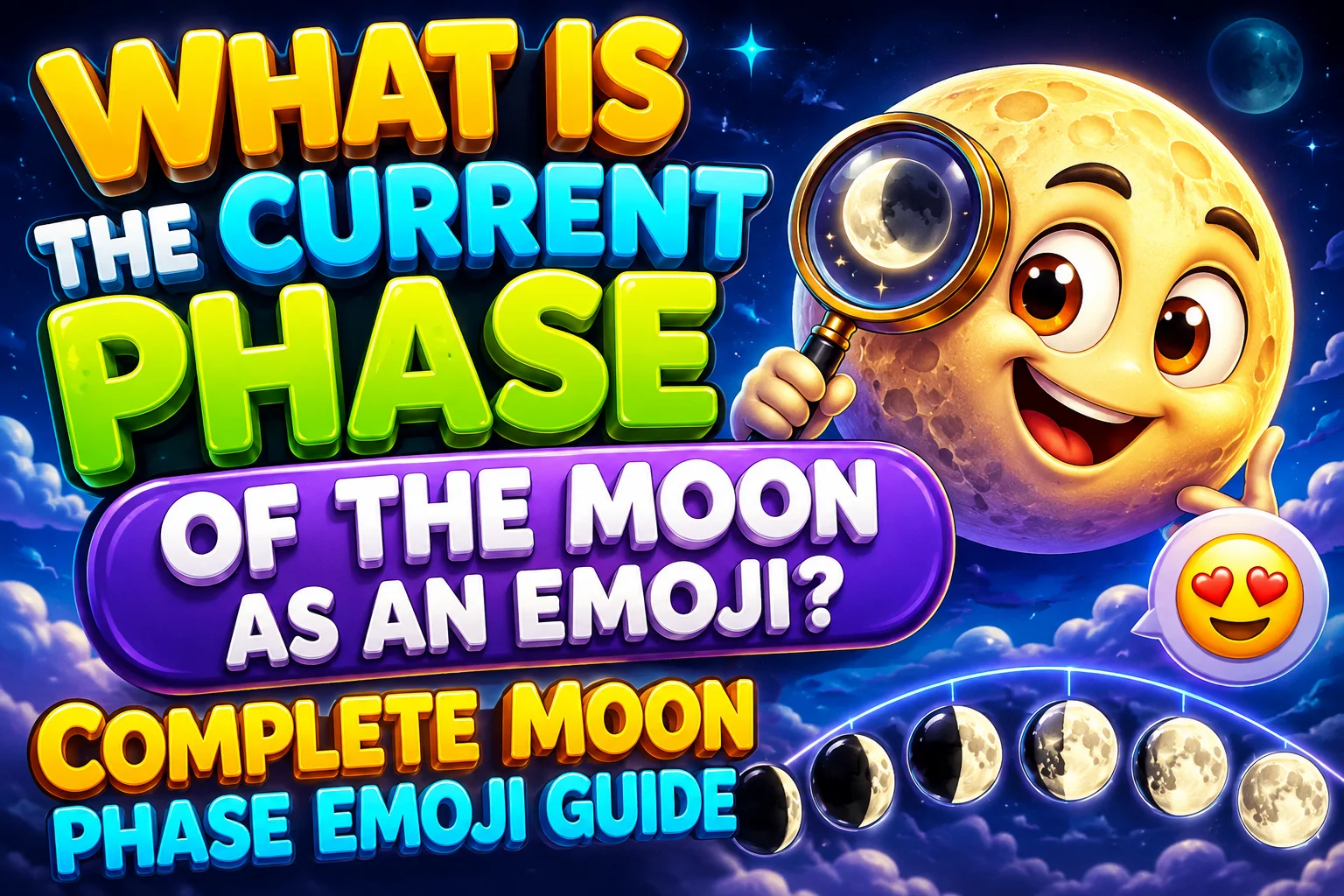
Have you ever looked at the night sky and wondered, “What is the current phase of the Moon as an emoji?” You’re not alone. This question has become surprisingly popular, especially among people solving online puzzles, updating lunar journals, posting on social media, or simply trying to match tonight’s Moon with the correct symbol.
The answer isn’t always as simple as picking 🌕. The Moon moves through a continuous cycle, and its appearance changes gradually throughout the month. Each major stage has a corresponding emoji, from the dark New Moon 🌑 to the bright Full Moon 🌕 and everything in between.
As of August 29, 2026, current lunar calendars show the Moon transitioning into a Waning Gibbous phase, with roughly 98–99% illumination depending on the exact location and observation time. The matching current moon phase emoji is 🌖. The Full Moon occurred around August 28, so the illuminated portion has now begun shrinking.
Understanding moon phase emojis becomes much easier once you know how the lunar cycle works. Let’s break it down without turning astronomy into a headache.
Quick Answer
The current phase of the Moon as an emoji is 🌖, the Waning Gibbous Moon, for August 29, 2026.
However, there’s an important catch: the current moon phase changes over time. A Moon phase answer can differ depending on the date, time, and sometimes your location.
Here is the complete sequence of major Moon phase emojis:
🌑 → 🌒 → 🌓 → 🌔 → 🌕 → 🌖 → 🌗 → 🌘
These represent:
- 🌑 New Moon
- 🌒 Waxing Crescent
- 🌓 First Quarter
- 🌔 Waxing Gibbous
- 🌕 Full Moon
- 🌖 Waning Gibbous
- 🌗 Last Quarter
- 🌘 Waning Crescent
The cycle then starts again.
Comparison Overview
The easiest way to understand the current phase of the Moon as an emoji is to compare all eight major phases side by side. Each emoji represents a recognizable stage in the Moon’s approximately 29.5-day cycle.
| Moon Phase | Emoji | Illumination Trend | What It Means |
| New Moon | 🌑 | 0% visible | Beginning of a new lunar cycle |
| Waxing Crescent | 🌒 | Increasing | A small illuminated crescent appears |
| First Quarter | 🌓 | Increasing | About half the visible disk is illuminated |
| Waxing Gibbous | 🌔 | Increasing | More than half is illuminated |
| Full Moon | 🌕 | Nearly 100% | The visible face appears fully illuminated |
| Waning Gibbous | 🌖 | Decreasing | Illumination begins shrinking |
| Last Quarter | 🌗 | Decreasing | About half remains illuminated |
| Waning Crescent | 🌘 | Decreasing | Only a thin crescent remains |
One simple fact makes this chart easier to remember: waxing means growing, while waning means shrinking.
Think of the Moon like a lamp slowly turning up its brightness. That’s waxing. After reaching maximum brightness, the lamp gradually dims. That’s waning.
Main Differences Between Current Moon Phase Emojis
The biggest difference between moon phase emojis is how much of the Moon appears illuminated and whether that illumination is increasing or decreasing.
Waxing vs. Waning
The terms waxing and waning tell you which direction the lunar cycle is moving.
Waxing phases:
- 🌒 Waxing Crescent
- 🌓 First Quarter
- 🌔 Waxing Gibbous
During these phases, the visible illuminated portion grows larger each night.
Waning phases:
- 🌖 Waning Gibbous
- 🌗 Last Quarter
- 🌘 Waning Crescent
During these phases, the illuminated portion becomes smaller.
The New Moon 🌑 marks the beginning of the cycle, while the Full Moon 🌕 represents its brightest major stage.
Crescent vs. Gibbous
Another useful distinction involves the words crescent and gibbous.
A crescent Moon has less than half of its visible surface illuminated.
A gibbous Moon has more than half illuminated but isn’t yet full.
That’s why 🌒 and 🌘 look thin, while 🌔 and 🌖 appear much rounder.
First Quarter vs. Last Quarter
These two phases often confuse people because both appear half illuminated.
- 🌓 First Quarter occurs while the Moon is waxing.
- 🌗 Last Quarter occurs while the Moon is waning.
The difference isn’t simply appearance. It tells you where the Moon sits in its journey through the lunar cycle.
What Does “Current Phase of the Moon as an Emoji” Mean?
The phrase “current phase of the Moon as an emoji” means finding the emoji that best represents the Moon’s actual astronomical phase on a particular date.
For example, imagine checking the sky and discovering that the Moon is in its Full Moon phase. The matching emoji would be:
🌕
If the Moon has moved past the Full Moon and its illuminated portion is shrinking, you would use:
🌖
This search query often appears simple, but it combines two separate ideas:
- Astronomy: What phase is the real Moon currently in?
- Emoji matching: Which Unicode emoji represents that phase?
The emoji doesn’t track the sky automatically. You must first identify the actual lunar phase and then choose the corresponding symbol.
That’s an important distinction.
The Complete Moon Phase Emoji Chart
Here is a more detailed reference for all eight major Moon phases.
| Phase | Emoji | Description | Cycle Direction |
| New Moon | 🌑 | Moon appears dark from Earth | Beginning |
| Waxing Crescent | 🌒 | Thin crescent grows | Increasing |
| First Quarter | 🌓 | Half of the visible disk appears lit | Increasing |
| Waxing Gibbous | 🌔 | More than half illuminated | Increasing |
| Full Moon | 🌕 | Nearly complete illumination | Peak |
| Waning Gibbous | 🌖 | More than half remains illuminated | Decreasing |
| Last Quarter | 🌗 | Half illuminated | Decreasing |
| Waning Crescent | 🌘 | Thin crescent shrinks | Decreasing |
You can copy and paste these symbols whenever needed:
🌑 🌒 🌓 🌔 🌕 🌖 🌗 🌘
🌑 New Moon Emoji Meaning
The New Moon 🌑 marks the start of a new lunar cycle.
During this phase, the side of the Moon facing Earth receives very little direct sunlight. As a result, the Moon appears almost completely dark in the sky.
Astronomically, the New Moon occurs when the Moon sits roughly between Earth and the Sun.
People commonly use 🌑 to represent:
- New beginnings
- Darkness
- Fresh starts
- A new lunar month
- Mystery
- Nighttime themes
For example:
“Starting fresh today 🌑”
In casual communication, the emoji can carry symbolic meaning beyond astronomy. Still, its primary meaning remains the New Moon phase.
🌒 Waxing Crescent Moon Emoji Meaning
After the New Moon, a small illuminated sliver becomes visible. This stage is called the Waxing Crescent, represented by 🌒.
The word waxing means increasing.
Each night, a little more of the Moon’s visible surface becomes illuminated. The change may seem subtle from one evening to the next, but over several days, the difference becomes obvious.
You might use 🌒 for:
- Growth
- New opportunities
- Gradual progress
- Early stages of a project
For example:
“Small progress is still progress 🌒”
It’s a fitting symbol for something that has begun but hasn’t yet reached its full potential.
🌓 First Quarter Moon Emoji Meaning
The First Quarter Moon 🌓 appears when approximately half of the visible lunar disk is illuminated.
Here’s where the name causes confusion.
Many people assume a “First Quarter” Moon should look only 25% illuminated. It doesn’t.
The term refers to the Moon’s position through its orbital cycle, not the percentage of its visible surface that appears lit.
At this point, the Moon has completed roughly one-quarter of its journey through the lunar cycle.
The emoji 🌓 can represent:
- Progress
- Momentum
- Halfway points
- Important decisions
- Moving forward
It sits right in the middle of the waxing journey.
🌔 Waxing Gibbous Moon Emoji Meaning
The Waxing Gibbous Moon 🌔 appears after the First Quarter and before the Full Moon.
More than half of the Moon’s visible surface is illuminated, and the bright area continues growing.
The word gibbous simply describes a shape that is more than half full but not completely full.
This phase often feels like the final stretch before a major event.
Think of it like a stadium filling up before the championship game. Most seats are occupied, and the atmosphere is building. The Full Moon is just around the corner.
People may use 🌔 to symbolize:
- Anticipation
- Development
- Building momentum
- Approaching completion
🌕 Full Moon Emoji Meaning
The Full Moon 🌕 is probably the most recognizable lunar emoji.
During this phase, the side of the Moon facing Earth appears fully illuminated by sunlight.
A Full Moon occurs when Earth lies roughly between the Sun and Moon.
The Moon isn’t producing its own light. It reflects sunlight.
That’s worth remembering because the Moon can look like a glowing lamp in the night sky, but it’s really acting more like a giant cosmic mirror.
The 🌕 emoji is commonly used for:
- Full Moon events
- Night photography
- Astronomy posts
- Completion
- Celebration
- Brightness
Example:
“The sky looks incredible tonight 🌕”
Full Moons are also popular in calendars, cultural traditions, and astronomical observations.
🌖 Waning Gibbous Moon Emoji Meaning
The Waning Gibbous 🌖 phase begins after the Full Moon.
More than half of the Moon remains illuminated, but the bright portion is now decreasing.
This is the current phase represented by 🌖 on August 29, 2026, shortly after the late-August Full Moon. Lunar calendars show the Moon at roughly 98–99% illumination and decreasing, although the exact percentage varies slightly by location and calculation method.
The word waning means shrinking or decreasing.
Symbolically, 🌖 can represent:
- Reflection
- Gradual change
- Letting go
- The period after completion
- Transition
For example:
“The big moment passed, and now it’s time to reflect 🌖”
The Waning Gibbous phase proves that the Moon doesn’t suddenly switch from Full Moon to half Moon. The transition happens gradually.
🌗 Last Quarter Moon Emoji Meaning
The Last Quarter Moon 🌗 occurs during the second half of the lunar cycle.
Like the First Quarter, approximately half of the visible lunar disk appears illuminated.
However, the Moon is now waning rather than waxing.
The key difference is simple:
- 🌓 is moving toward the Full Moon.
- 🌗 is moving away from the Full Moon.
The Last Quarter can symbolize:
- Reassessment
- Adjustment
- Transition
- Wrapping things up
It’s the lunar equivalent of looking at the calendar and realizing the month is winding down.
🌘 Waning Crescent Moon Emoji Meaning
The Waning Crescent 🌘 is the final major stage before the cycle returns to the New Moon.
Only a thin illuminated crescent remains visible.
The light continues shrinking until the Moon reaches the New Moon phase again.
Common symbolic associations include:
- Closure
- Rest
- Reflection
- Preparation
- Endings before new beginnings
For example:
“Closing one chapter and preparing for the next 🌘”
Soon after this phase, the cycle begins again with 🌑.
How the Moon Phase Cycle Works
The Moon’s phases follow a repeating pattern caused by the changing positions of the Sun, Earth, and Moon.
The complete sequence is:
🌑 New Moon → 🌒 Waxing Crescent → 🌓 First Quarter → 🌔 Waxing Gibbous → 🌕 Full Moon → 🌖 Waning Gibbous → 🌗 Last Quarter → 🌘 Waning Crescent → 🌑
A complete lunar cycle, often called a synodic month, lasts approximately 29.5 days.
The Moon doesn’t physically change shape.
Instead, as it travels around Earth, we see different amounts of its sunlit half.
That distinction clears up a common misconception.
The Moon is always a sphere. Our viewing angle changes.
A Simple Way to Visualize the Lunar Cycle
Imagine standing beside a ball and shining a flashlight on it.
The flashlight represents the Sun.
The ball represents the Moon.
As you walk around the ball, different portions of its illuminated surface become visible from your position.
Nothing about the ball’s shape changes.
Only your perspective changes.
That’s essentially what creates Moon phases.
Waxing vs. Waning: The Easiest Way to Remember
If you struggle to remember the difference, keep this simple rule in mind:
Waxing = growing brighter
Waning = becoming less illuminated
Here’s the full comparison:
| Waxing Phase | Matching Waning Phase |
| 🌒 Waxing Crescent | 🌘 Waning Crescent |
| 🌓 First Quarter | 🌗 Last Quarter |
| 🌔 Waxing Gibbous | 🌖 Waning Gibbous |
The Full Moon 🌕 sits between the waxing and waning portions of the cycle.
One side builds up.
The other winds down.
Why Does the Current Moon Phase Emoji Change?
The current moon phase emoji changes because the Moon continuously moves through its orbit around Earth.
You might see 🌕 today and 🌖 tomorrow.
Several days later, 🌗 may become the better match.
Eventually, the Moon reaches 🌑 and starts the sequence again.
This is why articles about today’s Moon phase require current information. An answer written months ago may be completely wrong today.
For date-specific questions, always check a current lunar calendar rather than relying on an old screenshot or social media post.
Does Your Location Affect the Current Moon Phase Emoji?
Yes, but usually in a subtle way.
The astronomical phase itself is a global event, yet the exact time, illumination percentage, and visible appearance can vary depending on your location and time zone.
For example, a Full Moon may occur late at night in one country but after midnight in another.
That can create situations where:
- One location still considers it the previous calendar day.
- Another location has already moved into the next day.
- Lunar calendars display slightly different percentages of illumination.
On August 29, 2026, sources for Pakistan show the Moon immediately after the Full Moon and classify it as Waning Gibbous, with illumination near 99%.
So, if you’re searching for the current phase of the Moon as an emoji, checking your local date and time produces the most reliable result
Do Moon Emojis Automatically Update With the Real Moon?
No.
This is one of the most common misunderstandings.
Moon emojis are static Unicode characters. They don’t connect to astronomical data, GPS coordinates, or a live lunar calendar.
Typing 🌕 doesn’t mean there is currently a Full Moon.
It simply displays the Full Moon emoji.
The same applies to every other phase:
- 🌑 is always the New Moon symbol.
- 🌒 is always Waxing Crescent.
- 🌕 is always Full Moon.
- 🌖 is always Waning Gibbous.
You must manually select the emoji that matches the current astronomical phase.
Moon Phase Emoji vs. the Real Moon
A real Moon phase changes continuously.
An emoji does not.
That’s the central difference.
The Real Moon
The Moon’s illumination changes gradually every hour.
Its position changes throughout the night.
Its appearance may look different depending on atmospheric conditions and your viewing location.
The Moon Emoji
An emoji simplifies the Moon into one of several recognizable categories.
It acts like a visual shortcut.
For example, if the Moon is 87% illuminated and shrinking, there isn’t a separate emoji specifically for “87% illuminated.” The closest standard category is 🌖 Waning Gibbous.
This makes moon phase emojis useful, even though they aren’t perfectly precise scientific illustrations.
Also Read This: What Does WYLL Mean in a Text? Meaning, Examples, Snapchat Use, and How to Reply
Why Do Moon Emojis Look Different on Different Devices?
You may notice that 🌕 looks slightly different on an iPhone, Android device, Windows computer, or social media platform.
That’s normal.
Unicode standardizes the character and its general meaning. However, each platform can create its own artwork.
As a result, one version may look:
- More realistic
- More cartoon-like
- More yellow
- More detailed
- More three-dimensional
The appearance changes, but the meaning remains the same.
A Full Moon emoji is still 🌕 regardless of whether your device displays it with subtle craters or a smooth cartoon surface.
How to Find Today’s Current Moon Phase Emoji
Finding the correct emoji only takes a few steps.
Check a Current Moon Phase Calendar
Look for a reliable astronomy or lunar calendar that provides:
- Today’s Moon phase
- Illumination percentage
- Moonrise time
- Moonset time
- Upcoming major phases
A current lunar calendar is especially useful when the Moon sits close to a phase transition.
For example, a Moon at 99% illumination may look almost identical to a Full Moon. However, astronomically, it may already be classified as a Waning Gibbous Moon.
Identify the Phase Name
Once you know the current phase, match it with the emoji chart.
Use the Matching Moon Emoji
Here is the quick conversion guide:
- New Moon → 🌑
- Waxing Crescent → 🌒
- First Quarter → 🌓
- Waxing Gibbous → 🌔
- Full Moon → 🌕
- Waning Gibbous → 🌖
- Last Quarter → 🌗
- Waning Crescent → 🌘
That’s all there is to it.
No telescope required.
How to Copy and Paste Moon Phase Emojis
Here are all eight major Moon phase emojis in one place:
Copy and Paste Moon Emojis
🌑 🌒 🌓 🌔 🌕 🌖 🌗 🌘
You can use them in:
- Text messages
- Instagram captions
- TikTok posts
- X posts
- Facebook updates
- Digital calendars
- Lunar journals
- School projects
- Astronomy discussions
- Online games
Their simplicity makes them surprisingly versatil.
Common Uses for Current Moon Phase Emojis
Social Media Captions
Moon emojis can instantly add atmosphere to a caption.
For example:
“Quiet night under the stars 🌖✨”
Or:
“Tonight’s Full Moon is stealing the show 🌕”
If you’re posting about the actual sky, matching the correct current moon phase emoji adds an extra layer of accuracy.
Text Messages
Moon emojis work naturally in casual conversations.
Examples include:
- “Goodnight 🌙”
- “Look at the Moon tonight 🌕”
- “The lunar eclipse was amazing 🌑”
- “Starting something new this week 🌒”
The context determines whether you’re using the emoji scientifically or symbolically.
Lunar Journals
Some people track the Moon as part of:
- Astronomy observations
- Gardening calendars
- Photography planning
- Personal journals
- Cultural calendars
Using emojis creates a fast visual record.
A journal filled with 🌑 🌒 🌓 🌔 🌕 immediately shows the rhythm of a lunar month without requiring lengthy descriptions.
Moon Phase Emoji Meanings Beyond Astronomy
Moon emojis often develop symbolic meanings.
While these interpretations aren’t scientific definitions, they’re common in creative writing and online communication.
| Emoji | Astronomical Meaning | Common Symbolic Meaning |
| 🌑 | New Moon | Beginning, mystery |
| 🌒 | Waxing Crescent | Growth, possibility |
| 🌓 | First Quarter | Progress, momentum |
| 🌔 | Waxing Gibbous | Preparation, anticipation |
| 🌕 | Full Moon | Completion, celebration |
| 🌖 | Waning Gibbous | Reflection, transition |
| 🌗 | Last Quarter | Change, reassessment |
| 🌘 | Waning Crescent | Closure, rest |
Symbolism can be useful, but it shouldn’t replace the actual astronomical meaning when accuracy matters.
A 🌕 in a poetic caption might simply represent beauty.
In an astronomy report, however, it specifically indicates a Full Moon.
Context is everything.
Common Mistakes When Choosing a Moon Phase Emoji
Confusing Waxing and Waning
This is probably the most common mistake.
Remember:
Waxing = growing
Waning = shrinking
If the illuminated portion increases, you’re moving toward 🌕.
If it decreases, you’re moving away from 🌕.
Mixing Up 🌒 and 🌘
Both are crescent phases.
However:
- 🌒 represents a Waxing Crescent
- 🌘 represents a Waning Crescent
They occur on opposite sides of the lunar cycle.
Confusing 🌔 and 🌖
These emojis both represent Gibbous phases.
The difference is timing:
- 🌔 comes before the Full Moon.
- 🌖 comes after the Full Moon.
Assuming 🌕 Means Tonight Is Always a Full Moon
The emoji itself doesn’t update.
Using 🌕 in a message doesn’t make it a live indicator.
You must check current lunar data first.
Relying on an Old Search Result
Moon phase information has an expiration date.
An article answering “What is today’s Moon?” can become outdated within hours or days.
Always check the publication date or use a current lunar calendar.
Case Study: Why Checking the Date Matters
Consider a simple example.
On August 28, 2026, lunar calendars marked the Full Moon event for this cycle in the relevant regional time frame. By August 29, the Moon had moved beyond its peak phase and was classified as a Waning Gibbous Moon, even though it remained roughly 98–99% illuminated.
To the naked eye, the difference might be difficult to notice.
That’s exactly why guessing can lead to the wrong emoji.
Someone looking casually at the sky might choose:
🌕 Full Moon
However, current lunar data would classify the phase as:
🌖 Waning Gibbous
The lesson is simple: visual appearance and astronomical classification aren’t always identical at a glance.
Current Moon Phase Emoji for Online Games and Puzzles
Some people search for the current Moon emoji because online games or puzzles require a date-specific answer.
One well-known example is The Password Game, which has used unusual rules involving changing information and puzzle requirements. In situations like these, guessing the Moon phase can quickly derail your progress.
The safest approach is straightforward:
- Check today’s date.
- Find the current lunar phase.
- Confirm the phase for your time zone if necessary.
- Match it with the correct emoji.
- Copy and paste the symbol.
Don’t assume that yesterday’s answer still works.
The Moon keeps moving whether your password is ready or not.
Quick Moon Phase Emoji Cheat Sheet
If you only need a fast answer, use this sequence.
Growing Brighter
🌑 → 🌒 → 🌓 → 🌔 → 🌕
New → Crescent → Half → Mostly Full → Full
Growing Darker
🌕 → 🌖 → 🌗 → 🌘 → 🌑
Full → Mostly Full → Half → Crescent → New
This simple progression helps you identify where the current Moon sits in the larger lunar cycle.
Interesting Facts About the Moon and Its Phases
The Moon has fascinated people for thousands of years. Here are a few useful facts that put the emoji chart into perspective.
The Moon Doesn’t Produce Its Own Light
Moonlight is reflected sunlight.
The Lunar Cycle Takes About 29.5 Days
The period from one New Moon to the next is approximately 29.5 days.
Moon Phases Change Gradually
The Moon doesn’t instantly jump from 🌔 to 🌕. Its appearance changes continuously.
We Usually Divide the Cycle Into Eight Major Phases
These eight stages provide a practical way to describe the Moon’s changing appearance.
A Full Moon Isn’t Always Exactly 100% Illuminated on Every Calendar Display
Different sources may round illumination percentages or calculate them at different observation times.
That’s why you may occasionally see slightly different numbers across lunar calendars.
The phase name is often more useful than obsessing over a fraction of a percentage point.
FAQs:
What Is the Current Phase of the Moon as an Emoji?
The answer depends on the current date and time. On August 29, 2026, the Moon is in the Waning Gibbous phase 🌖 in the referenced regional lunar calendars, with roughly 98–99% illumination.
What Emoji Is the Moon Tonight?
Check a current lunar calendar and match the phase with one of the eight standard moon emojis.
For example:
- Full Moon = 🌕
- Waning Gibbous = 🌖
- Last Quarter = 🌗
What Are the Eight Moon Phase Emojis?
The eight major Moon phase emojis are:
🌑 🌒 🌓 🌔 🌕 🌖 🌗 🌘
They represent the full lunar cycle from New Moon to Waning Crescent.
What Does 🌕 Mean?
Astronomically, 🌕 represents a Full Moon.
Symbolically, people may also use it for brightness, completion, nighttime, beauty, or celebration.
What Does 🌑 Mean?
🌑 represents the New Moon, the beginning of a new lunar cycle.
It can also symbolize beginnings, darkness, mystery, or a fresh start.
What Is the Difference Between 🌒 and 🌘?
🌒 represents a Waxing Crescent, meaning illumination is increasing.
🌘 represents a Waning Crescent, meaning illumination is decreasing.
What Is the Difference Between 🌔 and 🌖?
🌔 is a Waxing Gibbous Moon, occurring before the Full Moon.
🌖 is a Waning Gibbous Moon, occurring after the Full Moon.
Does the Moon Emoji Automatically Change Every Day?
No. Moon emojis are static characters.
You must manually select the emoji that matches the actual current Moon phase.
Why Does the Current Moon Emoji Change?
The Moon orbits Earth and moves through a repeating cycle of phases. As its visible illumination changes, the best matching emoji changes too.
Is the Moon Phase the Same Everywhere?
The astronomical cycle is shared globally, but local dates, times, Moon positions, and phase transition timing can vary by location and time zone.
Can I Copy and Paste Moon Phase Emojis?
Yes. Here they are:
🌑 🌒 🌓 🌔 🌕 🌖 🌗 🌘
Conclusion:
Finding the current phase of the Moon as an emoji becomes easy once you understand the eight major lunar stages. The real trick is remembering that emojis are static symbols while the actual Moon changes continuously.
Start by checking the current astronomical phase. Then match it to the correct emoji:
🌑 → 🌒 → 🌓 → 🌔 → 🌕 → 🌖 → 🌗 → 🌘
For August 29, 2026, the appropriate current Moon phase emoji is 🌖 Waning Gibbous, following the Full Moon phase and beginning the Moon’s gradual journey back toward the New Moon.
Whether you’re solving a puzzle, planning an astronomy post, updating a lunar journal, or simply looking up at the night sky, this eight-emoji guide gives you a quick and reliable way to translate the Moon’s changing appearance into a symbol everyone recognizes.