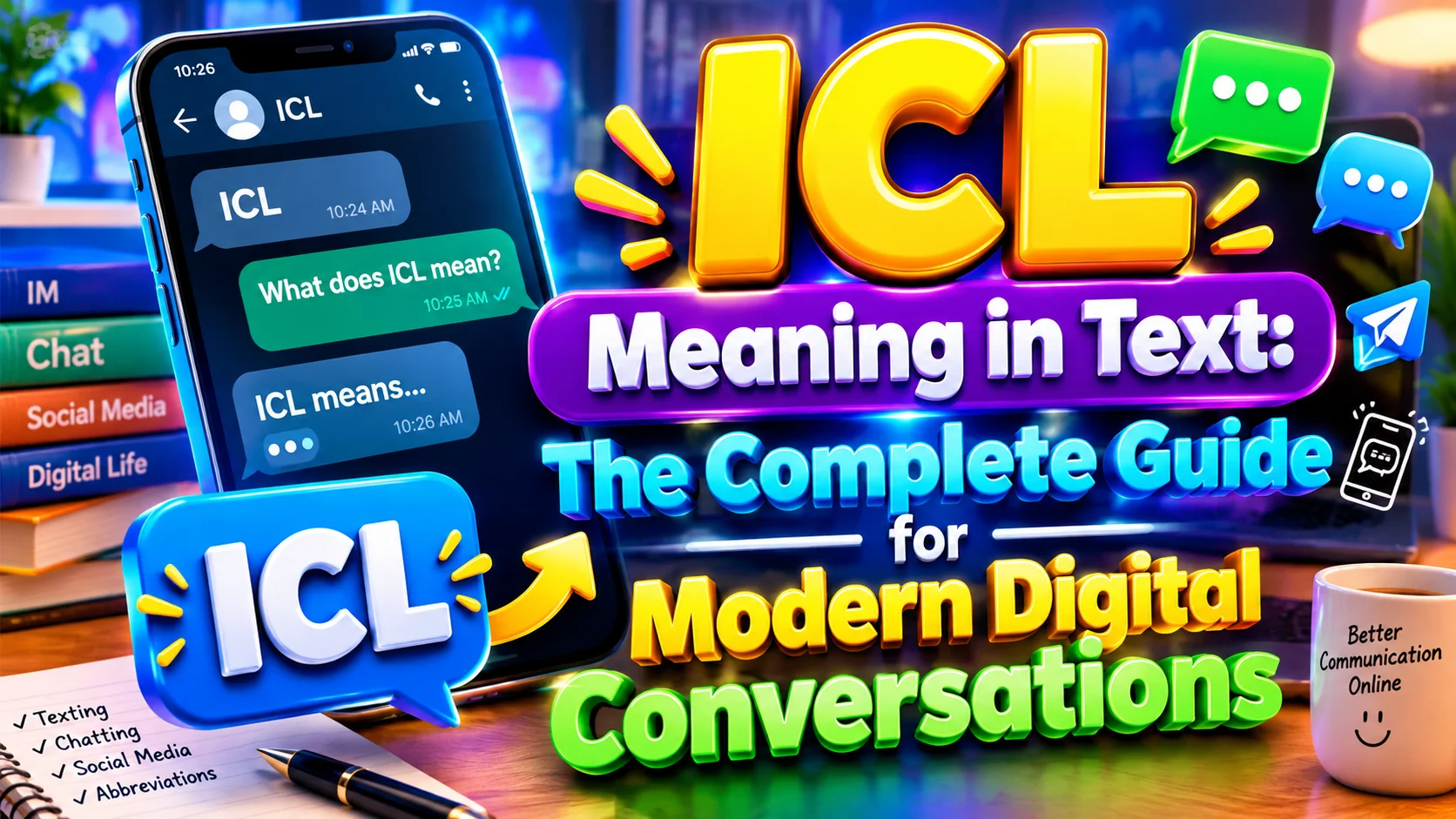
If someone sends you “ICL” in a text, comment, or social media message, the three letters can look confusing at first. Fortunately, the most common texting meaning is simple: ICL means “I Can’t Lie.”
People use ICL when they want to introduce an honest opinion, genuine reaction, personal admission, compliment, criticism, or feeling. In everyday online conversation, it often works much like “honestly,” “to be honest,” or “I have to admit.” Current slang references consistently identify “I Can’t Lie” as the primary internet-slang meaning.
For example, if someone writes “ICL, that movie was actually good,” they aren’t saying they literally cannot lie. They’re signaling that the opinion that follows is meant to sound candid or genuine.
That small distinction matters. ICL doesn’t determine the emotion of a message by itself. The words around it do. “ICL, you look amazing” feels very different from “ICL, I didn’t like the movie.”
This guide explains the ICL meaning in text, how people use it across social platforms, what it means in different contexts, how it compares with NGL and TBH, and when you should avoid using it.
Quick Answer
ICL usually means “I Can’t Lie” in texting, social media, and casual online conversations.
People use it to signal that they’re about to say something honestly or directly.
Example:
“ICL, that was one of the best episodes.”
This essentially means:
“I can’t lie, that was one of the best episodes.”
In simple terms:
ICL = I Can’t Lie = Honestly / To Be Honest
It is an informal internet abbreviation, so you’ll mainly find it in texts, DMs, comments, group chats, and other casual conversations rather than formal writing.
Comparison Overview
Before looking at detailed examples, here’s a quick comparison of ICL with several expressions that serve a similar purpose.
| Term | Full Meaning | Main Purpose | Typical Tone |
| ICL | I Can’t Lie | Introduces an honest statement | Casual |
| NGL | Not Gonna Lie | Introduces a candid opinion | Casual |
| TBH | To Be Honest | Signals honesty or directness | Casual |
| IMO | In My Opinion | Marks a personal viewpoint | Neutral |
| FR | For Real | Shows agreement or emphasis | Casual |
| No Cap | No lie / seriously | Emphasizes truthfulness | Very casual |
Although these expressions overlap, they aren’t completely interchangeable.
For instance, IMO directly marks something as an opinion. ICL, on the other hand, focuses more on the speaker’s honesty or willingness to say what they genuinely think.
That difference becomes clearer once you see ICL in actual conversations.
Main Differences Between ICL Meaning in Text and Similar Slang
The biggest difference is what the abbreviation emphasizes.
ICL emphasizes honesty.
NGL also emphasizes honesty, while TBH directly means “to be honest.” Meanwhile, IMO emphasizes that something represents a personal opinion.
Consider these examples:
- ICL, that restaurant was great. → “I can’t lie, that restaurant was great.”
- NGL, that restaurant was great. → “Not gonna lie, that restaurant was great.”
- TBH, that restaurant was great. → “To be honest, that restaurant was great.”
- IMO, that restaurant was great. → “In my opinion, that restaurant was great.”
They can communicate nearly the same idea in casual conversation. However, each abbreviation carries a slightly different conversational flavor.
What Does ICL Mean in Text?
In text messages, ICL means “I Can’t Lie.”
It usually appears when someone wants to make an honest observation or reaction. The abbreviation can appear at the beginning of a sentence, although people also place it at the end.
ICL at the Beginning
“ICL, I really enjoyed that game.”
Here, ICL prepares the reader for a sincere opinion.
ICL at the End
“That game was actually fun, ICL.”
The meaning remains essentially the same. The placement simply changes the rhythm of the message.
ICL Without Punctuation
Texting often ignores standard punctuation:
“icl that movie was actually good”
The lowercase spelling doesn’t change the meaning.
Internet slang frequently prioritizes speed and conversational flow over formal writing conventions. That’s why you’ll see ICL, icl, Icl, and similar variations in casual digital conversations. Current slang references describe the expression as an informal initialism used in online communication.
What Does ICL Stand For?
ICL stands for “I Can’t Lie.”
The phrase functions as a conversational lead-in. It tells the reader that the speaker is about to share something candid.
Think of it like opening a door before making a statement:
“ICL…”
Then comes the actual thought.
For example:
“ICL, I was nervous before the interview.”
The important information isn’t really the abbreviation itself. The abbreviation frames the following sentence as an honest admission.
Simple Formula
ICL + honest statement = candid reaction
Examples include:
- “ICL, I was wrong.”
- “ICL, I loved that song.”
- “ICL, I didn’t expect you to come.”
- “ICL, that was hilarious.”
- “ICL, I don’t agree.”
ICL Meaning in Slang
In modern internet slang, ICL generally means “I Can’t Lie.”
People use it as a shorthand expression in informal communication. It can introduce a:
- Personal opinion
- Confession
- Compliment
- Criticism
- Surprise
- Emotional reaction
- Agreement
- Admission
- Honest observation
The phrase doesn’t automatically make the following statement positive.
That’s an important point.
Compare:
“ICL, you did an amazing job.”
with:
“ICL, I didn’t like the ending.”
Both use ICL to signal honesty. One statement is positive while the other is critical.
So, ICL itself is emotionally neutral. The sentence determines the actual tone.
How Is ICL Used in Text Conversations?
ICL works in several common conversational situations.
ICL Before an Honest Opinion
This is probably the most straightforward use.
“ICL, I think the first movie was better.”
The writer wants to make their personal view clear without writing the entire phrase “I can’t lie.”
ICL Before an Admission
Someone might use it before admitting something slightly embarrassing.
“ICL, I forgot about the meeting.”
Here, ICL adds a candid quality to the admission.
ICL Before a Compliment
It can also introduce praise.
“ICL, your new haircut looks really good.”
The speaker presents the compliment as sincere.
ICL Before Criticism
ICL can also introduce a negative opinion.
“ICL, that update made the app harder to use.”
The abbreviation doesn’t make the criticism automatically polite. It simply frames it as the speaker’s honest reaction.
ICL Before a Surprising Reaction
“ICL, I didn’t expect to enjoy that concert.”
The phrase highlights the difference between what the speaker expected and what they actually experienced.
ICL Meaning on Social Media
The meaning generally stays the same across social platforms. What changes is the setting in which people use it.
You may encounter ICL in:
- TikTok comments
- Instagram comments
- Instagram DMs
- Snapchat messages
- WhatsApp chats
- Discord conversations
- Facebook comments
- X posts and replies
- Group chats
- Gaming communities
Recent online slang references also document ICL across these kinds of casual digital spaces.
ICL Meaning on TikTok
On TikTok, ICL can appear in comments, captions, replies, and conversations about videos.
For example:
“ICL this trend is actually funny 😂”
The commenter is basically saying:
“I can’t lie, this trend is actually funny.”
Another example:
“ICL, I wasn’t expecting that ending.”
The speaker is expressing a genuine reaction to the content.
Some online communities also combine ICL with other abbreviations. For example, documented slang usage includes expressions such as “ICL TS PMO,” where ICL retains its “I can’t lie” meaning.
That kind of stacking shows how internet slang can become highly compressed.
ICL Meaning on Snapchat
On Snapchat, ICL generally means “I Can’t Lie.”
Someone might write:
“ICL, that filter looks good.”
Or:
“ICL, I forgot to reply yesterday.”
Or:
“ICL, I miss hanging out.”
The meaning comes from the complete message rather than the three letters alone.
Does ICL Have a Special Snapchat Meaning?
Usually, no.
If you’re asking what ICL means on Snapchat specifically, the ordinary slang interpretation is still “I Can’t Lie.”
ICL Meaning on Instagram
Instagram users can use ICL in:
- DMs
- Comments
- Story replies
- Captions
- Notes
- Group conversations
For example:
“ICL, this might be your best picture.”
That’s simply a candid compliment.
Another example:
“ICL, I liked the old design better.”
Here, ICL introduces a personal preference.
ICL Meaning on WhatsApp
WhatsApp conversations tend to be highly conversational, making abbreviations like ICL easy to fit into everyday messages.
For example:
Friend: “Did you like the restaurant?”
You: “ICL, the food was better than I expected.”
The abbreviation makes the response feel casual rather than formal.
ICL Meaning on Discord
Discord communities often use compressed internet language because conversations move quickly.
You might see:
“ICL, that boss fight was brutal.”
Or:
“ICL, we need a better strategy.”
Or:
“ICL, that update fixed the game.”
The meaning remains “I Can’t Lie.”
What Does ICL Mean From a Girl?
When a girl uses ICL, the abbreviation itself doesn’t have a special female meaning.
It still usually means “I Can’t Lie.”
For example:
“ICL, you looked really good yesterday.”
That could be a simple compliment. Depending on the broader relationship and conversation, it could also carry additional personal meaning.
However, ICL itself doesn’t prove romantic interest.
Context matters far more than the abbreviation.
Look at:
- What she actually said
- What you were discussing
- The tone of the conversation
- Whether she uses slang frequently
- The relationship between you
Don’t treat one abbreviation as a secret code.
What Does ICL Mean From a Guy?
The same principle applies when a guy uses ICL.
If he writes:
“ICL, that was hilarious.”
He’s most likely emphasizing that he genuinely found something funny.
If he writes:
“ICL, I was worried.”
He’s making a personal admission.
The abbreviation doesn’t change meaning based on gender.
Is ICL Romantic?
Not by itself.
ICL can appear in romantic conversations because people naturally express honest feelings while texting someone they like. However, the abbreviation itself doesn’t mean flirting, attraction, or romantic interest.
Compare:
“ICL, that movie was amazing.”
with:
“ICL, I’ve missed talking to you.”
The second message contains emotional information. The abbreviation simply introduces the statement.
Read the whole message.
That’s the safest way to understand what someone actually means.
Is ICL Positive or Negative?
ICL can introduce positive, negative, or neutral statements.
| Tone | Example | Meaning |
| Positive | “ICL, you did great.” | Honest praise |
| Negative | “ICL, I didn’t like it.” | Honest criticism |
| Neutral | “ICL, I already ate.” | Straightforward admission |
| Surprised | “ICL, I didn’t expect that.” | Genuine surprise |
| Emotional | “ICL, I missed you.” | Honest feeling |
| Humorous | “ICL, that was ridiculous 😂.” | Candid reaction |
This flexibility explains why the abbreviation fits so many different conversations.
Is ICL Rude?
ICL isn’t inherently rude.
However, the statement that follows it can sound blunt.
For example:
“ICL, that shirt doesn’t look good.”
That’s direct criticism.
Now compare:
“ICL, I don’t think that color works as well.”
The second version still expresses disagreement, but it softens the delivery.
So when someone says “ICL,” don’t automatically interpret the message as aggressive. Look at the complete wording.
ICL Can Sound:
- Friendly
- Honest
- Casual
- Blunt
- Supportive
- Critical
- Funny
- Emotional
The surrounding language determines which one applies.
ICL Examples in Texting
Here are practical examples that show how people can use ICL naturally.
Honest Opinion
“ICL, that was the best episode.”
Meaning: The speaker genuinely thinks it was the best episode.
Personal Admission
“ICL, I was scared before the presentation.”
Meaning: The speaker openly admits feeling nervous or afraid.
Compliment
“ICL, your new profile picture looks great.”
Meaning: The compliment is presented as sincere.
Disagreement
“ICL, I think the other option was better.”
Meaning: The person is honestly expressing a different opinion.
Surprise
“ICL, I didn’t think you’d actually come.”
Meaning: The person genuinely didn’t expect the other person to arrive.
Food Review
“ICL, this burger is way better than I expected.”
Meaning: The speaker is giving an honest food review.
Gaming
“ICL, that level was ridiculously hard.”
Meaning: The player is emphasizing their genuine reaction.
School
“ICL, that test was harder than the practice questions.”
Meaning: The speaker is honestly describing their experience.
Also Read This: ROFL Meaning in Text: Modern Slang Explained Simply (2026)
ICL Conversation Examples
Seeing the abbreviation inside a complete conversation makes its purpose much easier to understand.
Example: Movie Discussion
Alex: “Did you enjoy the movie?”
Sam: “ICL, I expected it to be boring, but it was actually good.”
Here, ICL introduces an honest change of opinion
Example: Compliment
Alex: “What do you think of my new shoes?”
Sam: “ICL, they look really good.”
The abbreviation emphasizes sincerity.
Example: Admission
Alex: “Did you finish the assignment?”
Sam: “ICL, I completely forgot about it.”
Here, ICL introduces an honest admission.
Example: Disagreement
Alex: “That was definitely the best episode.”
Sam: “ICL, I liked the previous episode more.”
The speaker isn’t necessarily being rude. They’re simply stating a different opinion.
Example: Emotional Conversation
Alex: “Are you okay?”
Sam: “ICL, I’ve been having a rough week.”
Here, ICL introduces a more personal statement.
How to Understand ICL From Context
When you see ICL, don’t stop at the abbreviation.
Instead, use a simple four-part approach.
Look at the Words After ICL
The following statement usually reveals the intended tone.
“ICL, that was amazing.”
Positive.
“ICL, that was disappointing.”
Negative.
“ICL, I forgot.”
Neutral or apologetic.
Consider Your Relationship
A close friend might use ICL casually. Someone you barely know might use it simply as a way to make a comment sound candid.
Consider the Topic
A conversation about a movie, relationship, game, school assignment, or personal problem can completely change how the message feels.
Check Emojis and Punctuation
Compare:
“ICL 😂 that was wild”
with:
“ICL, I’m really proud of you.”
The first feels playful. The second feels sincere and supportive.
ICL vs. NGL
ICL and NGL are extremely similar.
- ICL = I Can’t Lie
- NGL = Not Gonna Lie
Both often introduce a candid thought.
Example
“ICL, this song is catchy.”
“NGL, this song is catchy.”
The meaning is almost identical.
The difference is mostly phrasing and personal style. Some people naturally prefer one abbreviation over the other.
Current slang references commonly group ICL with NGL and TBH as expressions that introduce honesty or directness.
ICL vs. TBH
TBH means “To Be Honest.”
It serves a similar purpose:
“TBH, I expected more.”
“ICL, I expected more.”
Both indicate that the speaker is giving a candid opinion.
However, the expressions aren’t grammatically identical.
ICL is built from a complete phrase: “I can’t lie.”
TBH directly announces honesty: “To be honest.”
In casual digital communication, both can work naturally.
ICL vs. IMO
IMO means “In My Opinion.”
This distinction is useful.
“ICL, that restaurant was great.”
Focus: honesty
“IMO, that restaurant was great.”
Focus: personal opinion
An opinion can be honest without needing ICL. Likewise, someone can use ICL before making a confession that isn’t really an opinion.
That’s why the abbreviations overlap without being exact synonyms.
ICL vs. FR
FR means “For Real.”
People often use FR to express agreement, emphasis, or sincerity.
For example:
“That movie was incredible.”
“FR.”
Here, FR essentially means “Seriously” or “For real.”
ICL usually introduces the speaker’s own statement:
“ICL, that movie was incredible.”
These expressions can appear together:
“ICL, that movie was amazing fr.”
That combination emphasizes both personal honesty and strong agreement.
Is ICL a Slang Word or Acronym?
ICL is better described as an initialism or internet abbreviation rather than a conventional English word.
Wiktionary specifically lists icl as an internet-slang initialism for “I can’t lie.”
People generally type the individual letters rather than treating ICL as an ordinary spoken word.
If someone reads it aloud, the natural approach is usually to say the letters:
“eye-see-el.”
In normal speech, however, people are more likely to say the full phrase “I can’t lie” rather than pronounce the abbreviation.
When Should You Use ICL?
ICL fits best in informal communication.
Good Places to Use ICL
- Text messages
- Casual DMs
- Group chats
- Social media comments
- TikTok comments
- Snapchat conversations
- Discord chats
- Gaming conversations
- Casual conversations with friends
Example
“ICL, that game was harder than I expected.”
That sounds completely natural in a casual chat.
When Should You Avoid ICL?
ICL isn’t a good choice for most formal writing.
Avoid it in:
- Business proposals
- Academic essays
- Job applications
- Formal reports
- Legal documents
- Official correspondence
- Professional emails
- Research papers
Instead of:
“ICL, I think this approach has problems.”
A professional message could say:
“To be honest, I think this approach has some limitations.”
Or:
“In my view, this approach has several limitations.”
The second versions communicate the same basic idea while matching a formal setting.
Common Misunderstandings About ICL
ICL Doesn’t Mean Someone Is Literally Unable to Lie
The phrase is figurative.
When someone writes:
“ICL, I love this song.”
They aren’t making a philosophical statement about their ability to lie.
They’re simply saying:
“Honestly, I love this song.”
ICL Doesn’t Automatically Mean Something Negative
Some people associate honesty with criticism.
That’s not necessary.
ICL can introduce a compliment:
“ICL, you’re really good at this.”
It can introduce excitement:
“ICL, this is so much fun.”
It can introduce criticism:
“ICL, I don’t like the new design.”
The following words determine the emotional direction.
ICL Doesn’t Automatically Mean Seriousness
Someone can use ICL before a joke:
“ICL 😂 that was the funniest thing ever.”
The abbreviation doesn’t turn the entire message into a serious declaration.
Context still controls the tone.
ICL Doesn’t Automatically Indicate Romantic Interest
If someone texts:
“ICL, you look amazing.”
That could be a compliment from a friend, family member, partner, or someone interested in the person.
The abbreviation alone can’t establish romantic intent.
Can ICL Have Other Meanings?
Yes.
Like many three-letter abbreviations, ICL can represent different terms outside internet slang.
For example, in healthcare, ICL can refer to an Implantable Collamer Lens, while International Computers Limited was the name of a historic British computer company.
There are also specialized meanings in different technical fields.
That’s why context matters.
| Context | Possible Meaning |
| Texting / social media | I Can’t Lie |
| Eye care | Implantable Collamer Lens |
| Computing history | International Computers Limited |
| Language coding | ICL may appear in specialized terminology |
For ordinary social-media conversations, however, “I Can’t Lie” is the relevant interpretation.
Why Do People Use ICL Instead of “I Can’t Lie”?
Three letters are quicker than three words.
That’s the basic appeal.
Digital communication often rewards brevity. People want their messages to feel fast, casual, and conversational. Abbreviations allow them to compress familiar phrases without losing much meaning.
Compare:
“I can’t lie, that was hilarious.”
with:
“ICL, that was hilarious.”
The second version feels more like a quick text or social-media comment.
Internet slang also creates a sense of shared language. When both people understand the abbreviation, the conversation can move faster without stopping to explain every phrase.
ICL in Modern Digital Conversations
ICL also illustrates something larger about online language: digital communication constantly compresses familiar expressions.
People rarely communicate online exactly as they would in an academic essay.
Instead, casual messages mix:
- Abbreviations
- Acronyms
- Emojis
- Slang
- Shortened words
- Informal punctuation
- Repeated letters
- Lowercase writing
ICL fits neatly into that environment.
Interestingly, current slang usage also shows ICL being combined with other abbreviations in highly compressed TikTok-style phrases. Documented examples include combinations such as “ICL TS PMO” and longer strings of abbreviations.
That doesn’t change the core meaning of ICL. It shows how internet vocabulary can evolve into dense shorthand.
A Simple Case Study: How ICL Changes a Message
Consider this conversation:
Person A: “Did you actually like the new game?”
Response One
“Yes, it was good.”
This gives a direct opinion.
Response Two
“ICL, it was really good.”
The second response adds a stronger sense of candidness.
Response Three
“NGL, it was really good.”
Very similar to ICL.
Response Four
“IMO, it was really good.”
This focuses more clearly on personal opinion.
The underlying idea stays similar, but each abbreviation slightly changes the framing.
That’s the real function of ICL: it frames the statement that follows as something the speaker genuinely thinks or feels.
How to Reply When Someone Says ICL
You don’t need a special response to ICL.
Respond to the actual statement that follows it.
If You Agree
“Honestly, same.”
“I agree.”
“Exactly.”
If You Disagree
“I see it differently.”
“Really? I thought the opposite.”
If Someone Shares Something Personal
“I appreciate you being honest.”
“Yeah, I understand.”
If Someone Compliments You
“Thank you!”
“That’s really nice of you.”
The abbreviation doesn’t require a separate reply.
ICL Meaning: Quick Facts
| Fact | Details |
| Primary meaning | I Can’t Lie |
| Category | Internet slang / initialism |
| Typical setting | Casual digital communication |
| Tone | Informal |
| Main purpose | Signal honesty or candor |
| Can introduce opinions? | Yes |
| Can introduce compliments? | Yes |
| Can introduce criticism? | Yes |
| Can express emotion? | Yes |
| Formal writing? | Generally avoid |
| Similar terms | NGL, TBH, IMO, FR |
| Gender-specific? | No |
The primary texting definition is supported by current slang references and dictionary-style entries.
FAQs:
What does ICL mean in text?
ICL usually means “I Can’t Lie.” People use it to introduce an honest opinion, reaction, admission, compliment, or personal statement.
What does ICL stand for in texting?
ICL stands for “I Can’t Lie.” In casual messages, it works much like “honestly” or “to be honest.”
What does ICL mean on Snapchat?
On Snapchat, ICL usually means “I Can’t Lie.” Someone might use it before sharing an honest reaction or personal feeling.
What does ICL mean on TikTok?
On TikTok, ICL commonly means “I Can’t Lie.” It can appear in comments, captions, replies, and casual conversations.
Is ICL the same as NGL?
They’re very similar.
ICL = I Can’t Lie
NGL = Not Gonna Lie
Both commonly introduce candid statements.
Is ICL rude?
No. ICL isn’t inherently rude. However, the statement following it can be blunt or critical. Always consider the full message.
Does ICL mean “I care less”?
Some online sources list alternative interpretations for the same three letters. However, in ordinary texting and social-media slang, “I Can’t Lie” is the primary meaning. Context should guide the interpretation.
Does ICL mean someone likes you?
Not necessarily. ICL doesn’t indicate romantic interest by itself. The surrounding conversation provides the relevant context.
Can you use ICL in a professional email?
It’s better to avoid it. ICL is informal internet slang. In professional writing, use phrases such as “to be honest,” “in my view,” or “I believe.”
How do you pronounce ICL?
When read as an abbreviation, ICL is normally pronounced by saying its individual letters. In ordinary speech, people generally use the full phrase “I can’t lie.”
Conclusion:
The simplest way to remember the ICL meaning in text is:
ICL = I Can’t Lie.
It’s an informal internet abbreviation that people use when they want to introduce an honest opinion, reaction, admission, compliment, criticism, or feeling.
You may see it on TikTok, Snapchat, Instagram, WhatsApp, Discord, X, Facebook, or ordinary text messages. The core meaning usually stays the same even though the surrounding conversation changes.
Most importantly, don’t interpret ICL by itself. Read the complete sentence.
“ICL, you’re amazing” carries a very different message from “ICL, I didn’t like it.” The abbreviation simply sets up the speaker’s candid statement.
So the next time someone sends “ICL”, you won’t need to scratch your head. In most casual digital conversations, they’re simply saying:
“I can’t lie.”
And whatever comes next is the part that tells you what they really mean.











1 thought on “ICL Meaning in Text: The Complete Guide for Modern Digital Conversations (2026)”