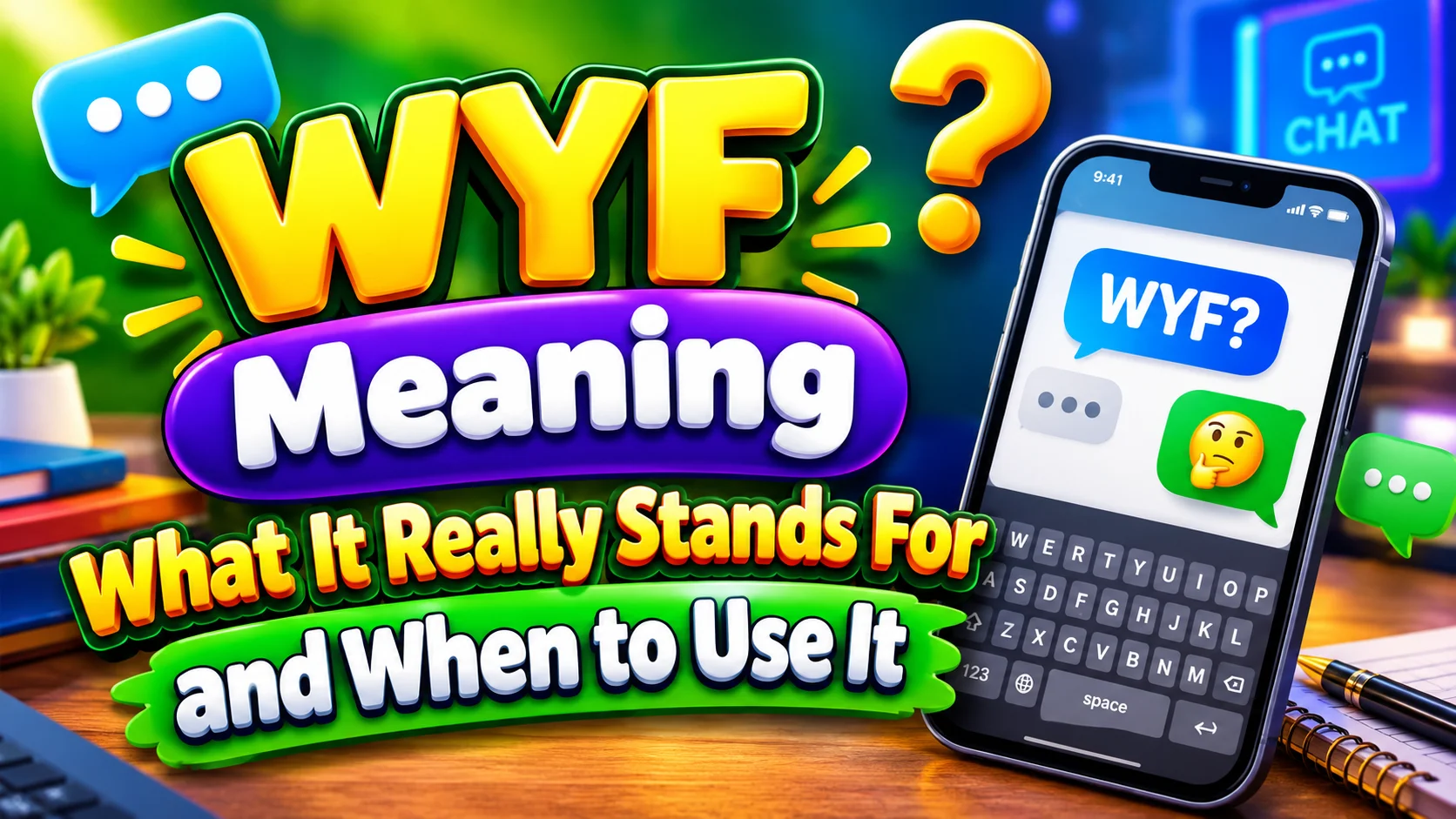
Have you ever received a text that simply says “WYF?” and wondered what the person actually wants to know? Three letters can carry a surprisingly specific meaning in casual online conversations. Like many texting abbreviations, WYF meaning depends on context, tone, and the people involved.
In most everyday texts, DMs, and social media conversations, WYF means “Where You From?” It’s a shortened, informal way to ask “Where are you from?” Someone might use it when getting to know you, asking about your hometown, or starting a conversation online.
However, WYF can sometimes have other interpretations. That’s why looking at the surrounding conversation matters before you answer. A message about hometowns has a very different clue set from a conversation about favorite movies or weekend plans.
This guide explains what WYF means, where people use it, how to respond, how it differs from similar abbreviations, and when you should avoid using it.
Quick Answer
WYF usually means “Where You From?” in texting, social media messages, and other informal online conversations.
It’s essentially a shortened version of “Where are you from?” People commonly use it when they want to know your:
- Hometown
- City
- State
- Country
- General background or place of origin
For example:
Person A: “Hey, WYF?”
Person B: “I’m from Dallas. You?”
The abbreviation is informal, so it works best in casual conversations. In a professional email, school assignment, or formal message, write “Where are you from?” instead.
The key point is simple: WYF most commonly refers to someone’s origin rather than their current location.
Comparison Overview
Before looking at the details, here’s a quick comparison of WYF and several abbreviations people often confuse with it.
| Abbreviation | Meaning | What It Usually Asks |
| WYF | Where You From? | Where someone is from |
| WYA | Where You At? | Where someone is currently |
| WYD | What You Doing? | What someone is doing |
| WBU | What About You? | The other person’s answer |
| WBY | What About You? | The other person’s answer |
| HBU | How About You? | The other person’s response |
There’s an important distinction between WYF and WYA.
If someone asks “WYF?”, they usually want to know your origin or hometown. If they ask “WYA?”, they generally want to know where you are right now.
For example:
- WYF? → “I’m from Phoenix.”
- WYA? → “I’m at the mall.”
That small difference can completely change the appropriate response.
Main Differences Between WYF Meaning and Similar Texting Abbreviations
The easiest way to understand WYF meaning is to compare it with abbreviations that look or sound similar.
WYF vs. WYA
WYF usually asks about your background or where you come from.
WYA usually asks about your present location.
Consider this conversation:
Friend: “WYF?”
You: “I’m from Atlanta.”
Later, the same friend might ask:
Friend: “WYA?”
You: “I’m downtown.”
The first question concerns origin. The second concerns current location.
WYF vs. WYD
These abbreviations have completely different purposes.
WYF = Where You From?
WYD = What You Doing?
Someone might text:
“WYF?”
You could answer:
“I’m from Chicago.”
But if they write:
“WYD?”
A natural response would be:
“Just watching a movie.”
WYF vs. WBU
WBU means “What About You?” It usually comes after someone has answered a question.
For example:
“I’m from Seattle. WBU?”
Here, WBU doesn’t ask where the person is from by itself. The previous sentence provides the context.
WYF vs. HBU
HBU means “How About You?”
It serves a similar conversational purpose to WBU. However, it isn’t a direct replacement for WYF.
For example:
“I’m originally from Denver. HBU?”
The person expects you to answer the same general question because the context establishes the subject.
What Does WYF Mean in Texting?
When someone sends WYF in a text message, the most common interpretation is “Where You From?”
The wording drops the words “are” from the standard question. This kind of shortening is common in digital communication because texting often favors speed and brevity.
Instead of writing:
“Where are you from?”
Someone may simply type:
“WYF?”
The meaning remains clear to people familiar with texting slang.
Why People Use WYF in Texts
People shorten phrases for several practical reasons:
- It takes less time to type.
- It fits the informal nature of texting.
- It feels casual and relaxed.
- It works well in fast-moving conversations.
- It matches the style of other texting abbreviations.
The abbreviation also helps establish an informal tone. A person who writes “WYF?” usually isn’t trying to sound polished or formal.
They’re chatting.
What Information Does WYF Request?
The exact answer depends on the conversation.
Someone asking “WYF?” might want to know:
- Your hometown
- Your current city if they use “from” loosely
- Your state
- Your country
- Where you grew up
- Your general geographic background
You don’t necessarily need to provide a precise location.
If someone asks:
“WYF?”
You could answer:
“I’m from California.”
You could also say:
“Originally from Boston.”
Both responses answer the question without giving unnecessary personal details.
What Does WYF Mean on Snapchat?
On Snapchat, WYF commonly means “Where You From?” when someone uses it in a casual chat.
Snapchat conversations often move quickly. Users may communicate with short messages, slang, abbreviations, emojis, photos, and videos. WYF fits naturally into that environment.
For example:
Snapchat user: “Nice pic! WYF?”
Reply: “I’m from Orlando. You?”
The abbreviation doesn’t have a special Snapchat-only meaning in ordinary conversation. The platform simply provides a common setting where casual shorthand appears.
WYF on Snapchat From Someone You Don’t Know
This situation deserves a little more attention.
If a stranger sends “WYF?”, they may simply be trying to start a conversation. They could also be curious about where you’re from after seeing your profile or content.
You don’t have to provide detailed information.
A broad response works well:
“I’m from Texas.”
Or:
“I’m in the Midwest.”
If you don’t feel comfortable sharing your location, you can keep your answer general or skip the question.
WYF Meaning on Instagram and TikTok
The same basic meaning applies to Instagram DMs, TikTok messages, and many other social platforms.
Someone might discover your profile, notice something about your background, and ask:
“WYF?”
For example, a person could hear an accent in a video and send:
“Your accent is cool. WYF?”
In this situation, “Where You From?” clearly fits the context.
WYF in Social Media DMs
Social media creates plenty of opportunities for strangers to meet. Because the conversation often begins with limited information, questions about location or background are common.
A typical exchange might look like this:
Person A: “Hey, your food videos are awesome.”
Person B: “Thanks!”
Person A: “WYF?”
Person B: “I’m from New Orleans.”
The question acts as a simple conversation opener.
However, don’t assume every person asking WYF wants to know your exact physical location. “Where are you from?” and “Where are you right now?” are different questions.
Also Read This: Smut Book Meaning: What It Is, Where It Came From, and Why Everyone Is Reading One
Other WYF Meanings You May Encounter
Although “Where You From?” is the most common texting interpretation, abbreviations can develop different meanings within specific groups or conversations.
That’s where context becomes important.
Some sources and online communities use WYF for alternative phrases such as “What You Feeling?” or “What’s Your Favorite?” These interpretations are much more dependent on the subject of the conversation.
“What You Feeling?”
In some casual conversations, WYF can be interpreted as “What You Feeling?”
The phrase can ask what someone wants, prefers, or feels like doing.
For example:
“We can get pizza or burgers. WYF?”
Here, the surrounding conversation concerns a choice. The intended meaning could be “What are you feeling?”
Context makes the interpretation possible.
“What’s Your Favorite?”
Some conversations may use WYF in the sense of “What’s Your Favorite?”
For example:
“WYF movie?”
In a conversation specifically about movies, someone could be asking about your favorite movie.
However, this interpretation isn’t something you should automatically assume whenever you see WYF. The surrounding words need to support it.
Why Alternative Meanings Cause Confusion
Texting slang doesn’t work like a dictionary with one fixed definition for every situation.
People create shortcuts within friend groups, online communities, fandoms, gaming circles, and social networks. As a result, an abbreviation can develop secondary meanings.
That’s why a useful rule is:
Don’t interpret an abbreviation by the letters alone. Read the conversation around it.
If someone sends only “WYF?”, the most natural interpretation is generally “Where You From?”
If the conversation discusses food, entertainment, choices, or preferences, another interpretation may become possible.
How to Know What Someone Means by WYF
When WYF meaning isn’t immediately clear, you can use a few simple clues.
Check the Previous Message
The message immediately before WYF often provides the strongest clue.
Suppose the conversation looks like this:
“I grew up in Miami.”
“Oh nice! WYF?”
The location-related meaning is obvious.
Now compare that with:
“We could watch a comedy or horror movie.”
“WYF?”
Here, the conversation may point toward a preference-related interpretation.
Look at What Comes After WYF
Words following the abbreviation can also reveal the intended meaning.
For example:
“WYF city?”
The location interpretation becomes highly likely.
Similarly:
“WYF movie?”
The conversation probably concerns a favorite movie.
Consider Who Sent It
The relationship between the people matters.
A close friend might use WYF casually. A stranger might use it as a conversation starter. Someone on a dating app might ask it while getting to know you.
The abbreviation itself doesn’t tell you the sender’s intention.
Consider the Conversation Topic
Use the subject as your guide.
| Conversation Topic | Likely Interpretation |
| Hometown | Where You From? |
| Travel | Where You From? |
| Accent | Where You From? |
| City or state | Where You From? |
| Choosing food | Possibly What You Feeling? |
| Choosing entertainment | Possibly a preference-related meaning |
| Unclear context | Ask for clarification |
When the context remains unclear, don’t overthink it. Just ask.
How to Respond When Someone Says “WYF?”
If someone asks “WYF?”, the easiest response is usually a short location or hometown answer.
Simple WYF Responses
You can say:
- “I’m from Chicago.”
- “I’m from Florida.”
- “Originally from Boston.”
- “I grew up in Seattle.”
- “I’m from Canada. You?”
The last example works especially well because it answers the question while keeping the conversation moving.
Friendly Responses
If you’d like to continue chatting, add a question.
“I’m from Houston. What about you?”
Or:
“Originally from Denver, but I live in Phoenix now. You?”
This gives the other person something to respond to.
If You Don’t Want to Share Your Exact Location
You don’t owe a stranger detailed information about where you live.
A general answer can protect your privacy while still keeping the conversation friendly.
For example:
- “I’m from Texas.”
- “I’m in the Northeast.”
- “Originally from the West Coast.”
- “I’d rather keep my location private.”
Avoid sharing sensitive details such as your home address or precise whereabouts with strangers.
Is WYF Rude?
WYF isn’t inherently rude. It’s simply informal.
Still, the tone can change depending on how someone uses it.
Compare:
“Hey! WYF?”
with:
“WYF”
The first may feel friendly. The second can feel blunt because it contains almost no conversational padding.
Text has no voice, facial expression, or body language. As a result, even ordinary questions can sometimes sound colder than intended.
Is WYF Flirty?
It can be used in a flirty conversation, but WYF doesn’t automatically mean someone is flirting.
For example, someone you met through a dating app might ask:
“WYF?”
They’re probably trying to learn more about you.
However, the same question from a gaming friend could have nothing romantic behind it.
Look at the full conversation, not one abbreviation.
When Should You Use WYF?
WYF works best when the conversation is informal.
Good situations include:
- Texting close friends
- Messaging acquaintances
- Casual social media DMs
- Dating-app conversations
- Gaming chats
- Informal online communities
- Conversations with people who regularly use abbreviations
If the other person already communicates with slang and shortened phrases, WYF won’t seem unusual.
Why WYF Works in Casual Communication
Digital conversations reward speed. People often type on small screens while doing something else. Short forms make communication faster without necessarily sacrificing meaning.
WYF also signals familiarity with informal online language.
Still, clarity should come first. If there’s a chance the recipient won’t understand the abbreviation, use the complete question instead.
When Shouldn’t You Use WYF?
Don’t use WYF in formal writing.
It’s too casual for situations where professional or standard English matters.
Avoid it in:
- Job applications
- Cover letters
- Business emails
- Academic assignments
- Research papers
- Formal reports
- Official correspondence
- Professional customer-service messages
Instead of:
“WYF?”
Use:
“Where are you from?”
Depending on what you actually want to know, you could also say:
- “Where are you based?”
- “Where did you grow up?”
- “Where are you originally from?”
These questions aren’t identical.
“Where are you based?” usually asks where someone currently lives or works.
“Where did you grow up?” asks about childhood or upbringing.
“Where are you originally from?” focuses more directly on someone’s origin.
Choosing the right wording prevents confusion.
WYF in Different Conversation Situations
The meaning and tone of WYF become clearer when you see it in realistic situations.
Case Study 1: Meeting Someone Online
Imagine two people meet in an online photography community.
Alex: “That mountain photo is incredible.”
Jordan: “Thanks! I took it last weekend.”
Alex: “Nice. WYF?”
Jordan: “I’m from Colorado. You?”
Here, WYF clearly means “Where You From?”
The question naturally follows a conversation about photography and travel.
Case Study 2: Dating App Conversation
A dating-app match might write:
“Hey! WYF? I noticed you like hiking.”
The person probably wants to know where you’re from or where you live. The question also provides an easy way to continue the conversation.
A natural response could be:
“I’m originally from Portland. I live in Salt Lake City now. What about you?”
Notice how the response gives useful context without revealing a precise address.
Case Study 3: Social Media DM
Suppose someone comments on your accent and then sends:
“Your accent is interesting. WYF?”
Here, the meaning is almost certainly “Where You From?”
You could respond:
“I’m from Ireland. Have you been there?”
The answer turns a basic abbreviation into a real conversation.
Case Study 4: Ambiguous WYF
Now imagine someone writes:
“Pizza or tacos? WYF?”
This isn’t the typical location context. The person may be using WYF to mean something related to what you’re feeling or prefer.
If you’re unsure, simply ask:
“Do you mean what I’m feeling or where I’m from?”
A quick clarification is better than confidently answering the wrong question.
Common Mistakes People Make With WYF
Understanding WYF meaning also means knowing what not to assume.
Mistake 1: Assuming WYF Always Means the Same Thing
The most common meaning is “Where You From?” but context can create alternate interpretations.
Don’t treat every abbreviation as completely universal.
Mistake 2: Confusing WYF With WYA
This is one of the easiest mistakes to make.
WYF generally asks where someone is from.
WYA generally asks where someone is now.
Remember:
WYF = origin
WYA = current location
Mistake 3: Sharing Too Much Information
A simple WYF question doesn’t require your full address.
If you’re speaking with someone you don’t know, give only the level of detail you’re comfortable sharing.
Mistake 4: Using WYF in Formal Communication
Texting slang belongs in casual communication.
A job recruiter asking where you’re from doesn’t need:
“WYF?”
A professional response would be:
“I’m originally from Atlanta.”
Mistake 5: Assuming WYF Is Flirty
The abbreviation doesn’t reveal romantic intent.
Someone may simply be curious about your background.
WYF Meaning and Privacy: How Much Should You Share?
Location questions deserve a little caution when they come from strangers.
If someone online asks “WYF?”, you can answer broadly without identifying exactly where you live.
Safer levels of detail
Broad:
“I’m from the United States.”
Moderate:
“I’m from Texas.”
More specific:
“I’m from Austin.”
You don’t need to progress to a street, neighborhood, apartment complex, workplace, or live location.
A useful principle is minimum necessary information. Give enough information to answer the question while keeping sensitive details private.
How WYF Fits Into Modern Texting Language
Texting abbreviations are part of a broader shift toward compressed digital communication.
People frequently shorten phrases such as:
- LOL — Laughing out loud
- BRB — Be right back
- IDK — I don’t know
- IMO — In my opinion
- TBH — To be honest
- WYD — What you doing?
- WYA — Where you at?
- WYF — Where you from?
These expressions save time and can create a casual conversational rhythm.
However, not every abbreviation works everywhere. Digital shorthand depends heavily on audience and setting.
A close friend may understand several abbreviations immediately. A professor, employer, client, or unfamiliar reader may not.
WYF Meaning: Quick Reference Table
| Question | Answer |
| What does WYF mean? | Where You From? |
| What is the standard English version? | Where are you from? |
| What does WYF usually ask about? | Someone’s origin, hometown, or background |
| Is WYF formal? | No |
| Where is WYF commonly used? | Texts, DMs, social media, and casual chats |
| Can WYF have other meanings? | Yes, depending on context |
| Is WYF automatically flirty? | No |
| Is WYF the same as WYA? | No |
| What does WYA usually ask? | Someone’s current location |
| What should you use in formal writing? | “Where are you from?” |
FAQs:
What does WYF mean in texting?
WYF most commonly means “Where You From?” It’s an informal way to ask “Where are you from?” People use it in texts, DMs, group chats, and other casual conversations.
What does WYF mean on Snapchat?
On Snapchat, WYF generally means “Where You From?” It commonly appears when someone wants to learn another person’s hometown, city, state, or general background.
What does WYF mean from a girl or guy?
The abbreviation itself doesn’t tell you whether someone is flirting. WYF simply asks a question, usually about where you’re from. The sender’s tone and the rest of the conversation provide better clues about their intentions.
Is WYF the same as WYA?
No. WYF usually means “Where You From?” while WYA usually means “Where You At?” WYF generally concerns someone’s origin. WYA generally concerns their current location.
Can WYF mean something other than “Where You From?”
Yes. Some people and communities use WYF for alternative phrases such as “What You Feeling?” or other preference-related expressions. However, these meanings depend heavily on context. When someone sends “WYF?” without additional clues, “Where You From?” is the most natural interpretation.
Conclusion:
WYF usually means “Where You From?” It’s a quick and casual way to ask someone about their hometown, origin, or general background.
The abbreviation works well in texts, social media DMs, gaming chats, dating conversations, and other informal settings. It doesn’t belong in formal writing where a complete question sounds clearer and more professional.
The biggest source of confusion comes from context. Although “Where You From?” is the primary interpretation, people sometimes use WYF differently. Look at the messages around it before deciding what the sender means.
And when you receive the question, remember that you control how much information you share. A city, state, country, or general region is often enough.
In short, if someone casually texts “WYF?”, they’re probably asking one simple thing.


![Gavin Casalegno Ethnicity, Italian Heritage, and Acting Career [2026]](https://grammarexparts.com/wp-content/uploads/2026/09/gavin-casalegno-ethnicity-italian-heritage-and-acting-career-2026-300x169.webp)






![Gavin Casalegno Ethnicity, Italian Heritage, and Acting Career [2026]](https://grammarexparts.com/wp-content/uploads/2026/09/gavin-casalegno-ethnicity-italian-heritage-and-acting-career-2026-150x150.webp)