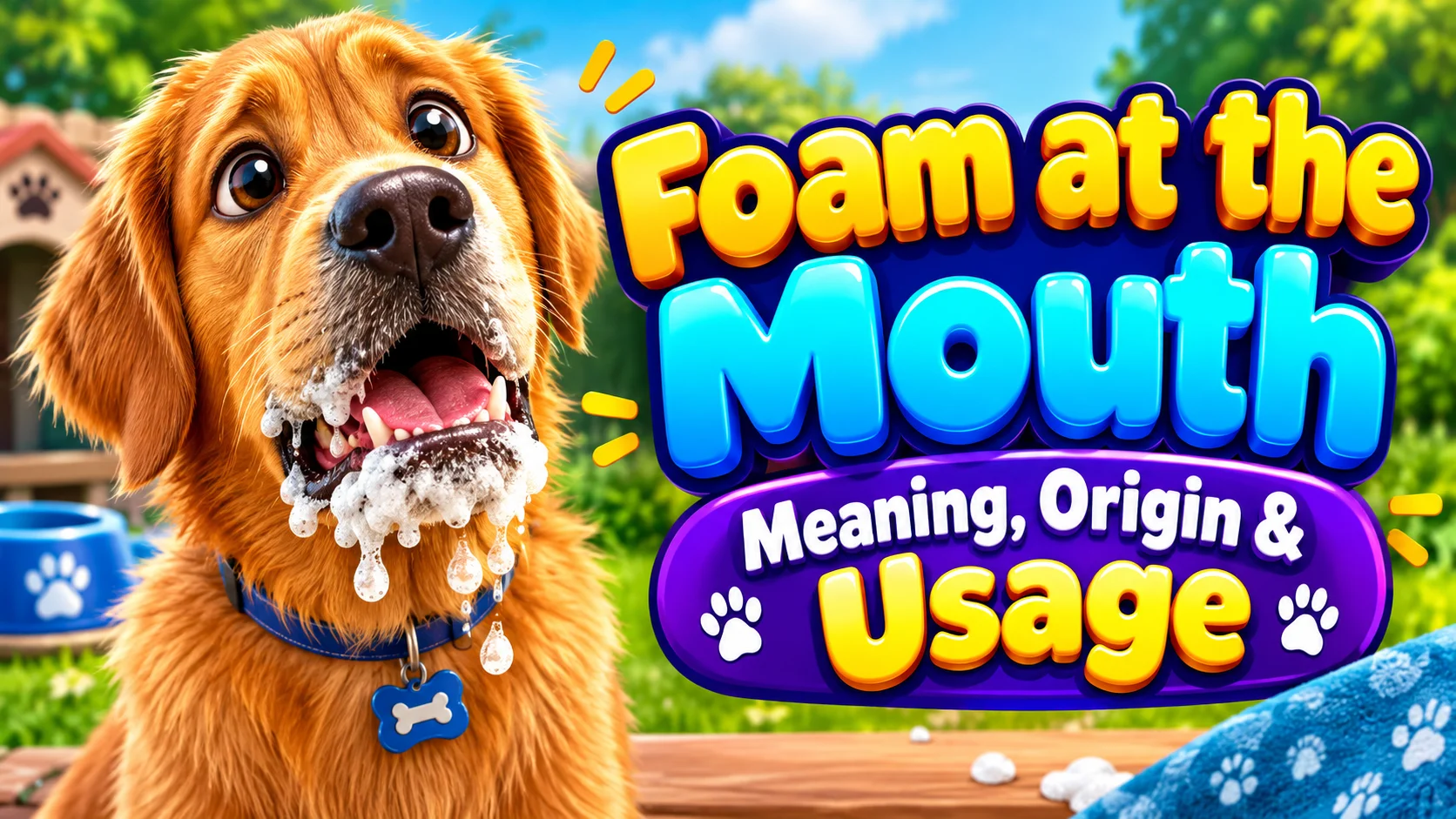
The phrase “foam at the mouth” paints a dramatic picture. You might imagine someone furious, shouting, and completely losing their temper. However, the expression also has a literal meaning involving bubbles or froth around the mouth.
That difference matters. In everyday conversation, “foam at the mouth” often describes extreme anger. In a literal context, it can describe an actual physical symptom in a person or animal. Major dictionaries recognize both uses, with Merriam-Webster specifically listing the figurative sense as informal.
The expression also has a surprisingly old history. English writers have used forms of foaming at the mouth for centuries, long before it became a familiar metaphor for rage. Historical references connect the image with illness, seizures, and other states involving frothy saliva.
Quick Answer:
“Foam at the mouth” means to have foam or frothy saliva around the mouth. Figuratively, it means to become extremely angry, furious, or emotionally worked up.
For example:
- Literal: “The dog was foaming at the mouth.”
- Figurative: “He was foaming at the mouth after hearing the decision.”
In the first sentence, the phrase describes something physically visible. Secondly, it exaggerates someone’s anger.
Merriam-Webster gives both meanings: producing foam because of illness or excitement and, informally, being very angry about something.
Comparison Overview
| Meaning | What it describes | Typical context | Tone |
| Literal foam at the mouth | Actual bubbles or frothy saliva around the mouth | Physical or medical description | Neutral or serious |
| Figurative foam at the mouth | Extreme anger or rage | Conversation, commentary, fiction | Dramatic or informal |
| Foaming at the mouth | A person or animal producing foam | Literal description | Usually serious |
| Foaming at the mouth with rage | Extreme emotional anger | Informal speech and writing | Strong and expressive |
| Foam at the mouth over something | Become extremely angry about something | Informal conversation | Dramatic |
The key is context. If someone describes a physical event, the phrase may be literal. If someone says a person “was foaming at the mouth over a political argument,” the meaning is almost certainly figurative.
Main Differences Between “Foam at the Mouth”
The phrase can cause confusion because its literal and figurative meanings sit very close together.
Literal “Foam at the Mouth”
The literal meaning refers to foam, froth, or bubbles appearing around the mouth. Dictionaries commonly associate this use with illness or other physical conditions. Cambridge, for example, defines the phrase as having bubbles coming from the mouth as a result of disease and gives examples involving convulsions and rabies.
Figurative “Foam at the Mouth”
The figurative meaning describes someone who is extremely angry or enraged.
For example:
“She was foaming at the mouth after the referee rejected her complaint.”
Nobody expects actual foam in this sentence. The speaker uses an exaggerated image to show that she was intensely angry.
Why the Difference Matters
Consider these two sentences:
- “The dog was foaming at the mouth.”
- “The customer was foaming at the mouth over the refund.”
The first sentence could describe a physical symptom. The second uses the expression as an idiom for intense anger.
That small shift in context completely changes the meaning.
What Does “Foam at the Mouth” Mean in Simple English?
In simple terms, to foam at the mouth means either to produce frothy saliva or to become extremely angry.
The figurative version is similar to saying:
- be furious
- be enraged
- lose your temper
- rage about something
- be extremely upset
- become intensely agitated
The phrase is much more vivid than simply saying “angry.”
Compare:
“He was angry about the decision.”
with:
“He was foaming at the mouth over the decision.”
The second sentence creates a much stronger image. It suggests anger that has become almost uncontrollable.
Literal Meaning of “Foam at the Mouth”
What Does It Mean Literally?
When used literally, foam at the mouth describes bubbles or frothy material around or coming from someone’s mouth.
Foam can form when saliva mixes with air. The phrase itself, however, doesn’t identify the underlying cause.
That distinction is important. “Foaming at the mouth” is a description, not a diagnosis.
Medical or emergency situations can involve excessive saliva, abnormal breathing, seizures, poisoning, or other serious conditions. Rabies can also produce excessive salivation and characteristic foaming in some affected animals, although the popular image of every rabid animal “foaming at the mouth” is an oversimplification. Cambridge specifically notes that some rabid animals foam at the mouth while most do not.
What Can Cause Foaming at the Mouth?
Possible causes depend heavily on the circumstances. Examples can include:
- Excess saliva mixed with air
- Seizures or convulsions
- Certain illnesses
- Toxic exposure or poisoning
- Conditions affecting swallowing
- Abnormal breathing with secretions
- Rabies in some animals
The phrase shouldn’t encourage anyone to diagnose a person or animal from appearance alone.
If someone suddenly develops unexplained foaming around the mouth, especially with loss of consciousness, seizures, breathing problems, severe confusion, or suspected poisoning, the situation can require urgent medical attention.
Figurative Meaning of “Foam at the Mouth”
The figurative expression means to be extremely angry or furious.
Collins defines the phrase as meaning that someone is very angry. It also records broader usage in which the expression can describe being extremely or uncontrollably angry.
The phrase often suggests more than ordinary irritation.
Someone who is mildly annoyed probably isn’t “foaming at the mouth.” The expression usually implies that the person’s emotional reaction has become intense, dramatic, or almost uncontrollable.
Example of Figurative Use
“Dad was foaming at the mouth when he saw the damage to his car.”
Here, the sentence doesn’t necessarily claim that Dad literally produced foam. Instead, it emphasizes how furious he became.
Another example:
“Fans were foaming at the mouth after their team lost the championship.”
This use is clearly exaggerated. It suggests extreme frustration and anger, especially among passionate fans.
Is “Foam at the Mouth” Always About Anger?
No.
Anger is the most common figurative meaning, but the literal meaning remains important.
Oxford’s learner dictionary gives two relevant uses. It describes animals as having bubbles around the mouth, especially when sick or angry. It then gives the informal human use meaning “to be very angry.”
The context usually provides the answer.
Compare These Examples
Literal:
“The veterinarian noticed that the dog was foaming at the mouth.”
This describes a physical observation.
Figurative:
“The commentator was foaming at the mouth during the debate.”
This describes an intensely angry reaction.
Clearly exaggerated:
“He’ll foam at the mouth when he hears this news.”
This means the speaker expects an extremely angry response.
Origin and History of “Foam at the Mouth”
The history of “foam at the mouth” reaches much further back than modern slang.
The underlying image comes from the literal appearance of froth or foam around the mouth. English has used related forms for many centuries. Dictionary.com notes that foam in the sense of frothing at the mouth was used in descriptions dating back to around AD 950, while the idiomatic expression developed much later.
Phrases.org.uk also identifies an early reference in the Lindisfarne Gospels, traditionally dated to around 950, and points to Shakespeare as an important early literary example of the expression in recognizable English.
Where Did the Expression Come From?
The expression developed from a striking physical image.
When people saw someone or an animal producing froth around the mouth, that image naturally suggested violent physical distress, illness, seizures, or extreme agitation.
Over time, writers could use the same image metaphorically.
Instead of describing actual foam, they could use the phrase to suggest that someone’s anger had become so intense that it looked almost physically uncontrollable.
That is how a literal observation can become a powerful figure of speech.
Why Is Foam Associated With Rage?
The connection works because foam looks uncontrolled and excessive.
Imagine a bottle shaken too hard. Pressure builds, bubbles multiply, and the contents spill over.
The phrase applies a similar mental picture to human emotion.
Someone who is “foaming at the mouth” figuratively isn’t merely irritated. Their anger appears to be boiling over.
The expression also gained strength from historical associations between foaming at the mouth, illness, seizures, and rabies. That combination created an especially vivid image of someone behaving in a seemingly uncontrollable way.
However, it’s worth separating historical imagery from medical fact. Anger itself doesn’t mean a person will literally foam at the mouth.
Historical and Literary Usage
One particularly notable literary reference appears in William Shakespeare’s Julius Caesar.
In the play, Caesar is described as having fallen in the marketplace and foamed at the mouth during a physical episode. Phrases.org.uk identifies this as an early recognizable literary example from Shakespeare’s work.
The expression also appears in Cymbeline, where Shakespeare uses the image in a description of an enraged character. Wiktionary’s historical citations identify an early seventeenth-century use in which a character is described as having “foam’d at the mouth” while threatening someone.
These examples demonstrate something important: the expression wasn’t invented recently as internet slang. Its imagery has been part of English usage for centuries.
“Foam at the Mouth” as an Idiom
An idiom is an expression whose intended meaning goes beyond its literal words.
“Foam at the mouth” fits that description when it means to be extremely angry.
You don’t need to imagine actual foam. Instead, you interpret the phrase as a dramatic description of rage.
For example:
“She’ll foam at the mouth if she finds out.”
The speaker isn’t necessarily predicting a physical symptom. The sentence means:
“She’ll become extremely angry if she finds out.”
This figurative use is informal and expressive. Oxford identifies the human meaning as informal, while Merriam-Webster similarly labels the anger sense informal.
“Foam at the Mouth” Examples in Different Contexts
In Everyday Conversation
“Don’t tell Mark about the broken window. He’ll foam at the mouth.”
Meaning: Mark will become extremely angry.
“She was foaming at the mouth after missing the flight.”
Meaning: She was extremely upset or angry.
In Social Media and Texting
Online discussions often use the phrase hyperbolically.
“People were foaming at the mouth over the new phone design.”
Here, the writer probably means that people reacted with intense emotion. The phrase adds drama and humor.
It can also appear in arguments:
“He’s foaming at the mouth because someone disagreed with him.”
The wording suggests that the person’s reaction seems wildly excessive.
In News or Commentary
The phrase can make commentary more vivid:
“Critics were foaming at the mouth over the controversial proposal.”
This is much more colorful than saying “critics were angry.”
However, the expression carries a strong rhetorical tone. It isn’t ideal when a writer needs completely neutral language.
In Fiction and Storytelling
Writers can use the phrase to portray an emotionally explosive character:
“By the time the argument ended, he was practically foaming at the mouth.”
The word “practically” makes the figurative nature obvious while preserving the dramatic effect.
20 Example Sentences Using “Foam at the Mouth”
Figurative Examples
- He was foaming at the mouth after hearing the referee’s decision.
- She’ll foam at the mouth when she sees what happened.
- The politician’s critics were foaming at the mouth over the proposal.
- My brother was foaming at the mouth after losing the game.
- The customer was practically foaming at the mouth during the argument.
- Fans were foaming at the mouth after their team’s unexpected defeat.
- He started foaming at the mouth when someone challenged his opinion.
- The manager was foaming at the mouth after discovering the mistake.
- Online commenters were foaming at the mouth over the controversial announcement.
- She was so angry that her friends joked she’d start foaming at the mouth.
Literal Examples
- The dog was found foaming at the mouth and behaving strangely.
- The veterinarian examined the animal after noticing foam around its mouth.
- The patient was reportedly foaming at the mouth during the seizure.
- The unusual foam around the animal’s mouth concerned the owner.
- They noticed the horse foaming at the mouth after intense exertion.
Humorous or Exaggerated Examples
- He’ll foam at the mouth if anyone touches his carefully organized desk.
- My sister nearly foamed at the mouth when she saw the surprise bill.
- Fans were foaming at the mouth over the final few seconds.
- She was practically foaming at the mouth while defending her favorite restaurant.
- The internet seemed to foam at the mouth over the celebrity’s latest post.
“Foam at the Mouth” vs. “Foaming at the Mouth”
These expressions are closely related, but their grammar differs.
Foam at the Mouth
This is the base form:
“He may foam at the mouth when he hears the news.”
It often appears after modal verbs such as may, might, will, could, or would.
Foaming at the Mouth
This is the -ing form:
“He was foaming at the mouth when he heard the news.”
It’s especially common when describing an action or state happening at a particular moment.
Quick Grammar Comparison
| Form | Example |
| foam at the mouth | “He may foam at the mouth.” |
| foams at the mouth | “He foams at the mouth whenever politics comes up.” |
| foamed at the mouth | “He foamed at the mouth during the argument.” |
| foaming at the mouth | “He was foaming at the mouth during the debate.” |
The meaning remains closely connected across these forms.
Is “Foam at the Mouth” a Negative Expression?
Usually, yes.
When used figuratively, “foam at the mouth” has a strongly negative or dramatic flavor. It portrays anger as excessive and difficult to control.
Still, context can soften the expression.
For example:
“My dad will foam at the mouth if he sees this mess.”
This could be a humorous exaggeration within a family conversation.
By contrast:
“The employee was foaming at the mouth during the meeting.”
That wording sounds much harsher. It portrays the employee as extremely angry and possibly unreasonable.
Also Read This: Bombastic Side Eye – Meaning, Origin & Usage
Is “Foam at the Mouth” Offensive?
The expression isn’t a swear word, slur, or inherently offensive term.
However, describing another person as “foaming at the mouth” can sound insulting.
Why? The phrase compares human behavior with an image commonly associated with uncontrolled animals or severe illness.
For that reason, it can sound mocking when directed at someone.
Consider the Difference
Less neutral:
“He was foaming at the mouth during the meeting.”
More neutral:
“He became extremely angry during the meeting.”
More professional:
“He expressed strong frustration during the meeting.”
The best choice depends on your audience and purpose.
Is “Foam at the Mouth” Professional?
Generally, no—not in formal or professional communication.
The phrase is expressive and informal. Oxford labels the figurative human use informal, and Merriam-Webster does the same.
You might see it in an opinion column or informal commentary. A business report, medical record, workplace email, or formal complaint would usually benefit from more precise language.
Better Professional Alternatives
Instead of:
“The client was foaming at the mouth.”
Try:
- The client was extremely upset.
- The client expressed significant frustration.
- The client became visibly angry.
- The client strongly objected to the decision.
- The client reacted angrily to the proposal.
These alternatives communicate the situation without adding unnecessary drama.
Synonyms and Alternatives for “Foam at the Mouth”
When You Mean Extreme Anger
Useful alternatives include:
- Be furious
- Be enraged
- Be livid
- Be seething
- Lose one’s temper
- Rage
- Become extremely angry
- Be beside oneself with anger
For example:
“She was foaming at the mouth over the decision.”
can become:
“She was absolutely furious about the decision.”
The second sentence sounds more direct and less figurative.
When You Mean Emotional Agitation
Depending on the situation, you could use:
- Become highly agitated
- Get extremely worked up
- Become visibly upset
- React intensely
- Become emotionally charged
These expressions don’t always mean anger, so choose carefully.
When You Mean the Literal Physical Condition
For literal situations, more precise descriptions include:
- Foamy saliva
- Frothing at the mouth
- Foam around the mouth
- Excessive salivation
- Bubbles around the mouth
Medical writing should describe observable symptoms rather than assume a cause.
Common Mistakes With “Foam at the Mouth”
Assuming It Always Means Anger
The phrase has a literal meaning too. Always check the surrounding sentence.
Treating It as a Medical Diagnosis
“Foaming at the mouth” describes an observation. It doesn’t establish the reason behind it.
Confusing “Foam at the Mouth” With “Foaming at the Mouth”
Both expressions relate to the same idea, but their grammatical roles differ.
Using It in Formal Communication
The figurative version can sound dramatic or mocking. A neutral alternative usually works better in professional settings.
Assuming Rabies Always Causes Foaming
That popular image isn’t medically reliable. Cambridge specifically notes that although some rabid animals foam at the mouth, most do not.
When Should You Use “Foam at the Mouth”?
Use “foam at the mouth” when you want to describe intense anger in a vivid, informal way.
It works especially well in:
- Casual conversations
- Humorous comments
- Fiction
- Opinion writing
- Informal online discussions
- Dramatic storytelling
For example:
“He’ll foam at the mouth when he hears about the new rule.”
The phrase immediately tells the reader that his reaction will be intense.
When Should You Avoid “Foam at the Mouth”?
Avoid the figurative expression when precision matters more than dramatic effect.
That includes:
- Medical documentation
- Professional reports
- Workplace complaints
- Formal correspondence
- Sensitive personal discussions
- Objective descriptions of someone’s behavior
Instead of saying someone “foamed at the mouth,” describe what actually happened.
For example:
“The customer raised his voice and repeatedly demanded a refund.”
That’s more useful than simply saying:
“The customer was foaming at the mouth.”
The first sentence gives the reader observable information.
Literal vs. Figurative Meaning: Quick Comparison
| Feature | Literal Use | Figurative Use |
| Meaning | Foam or froth physically appears around the mouth | Someone is extremely angry |
| Type | Physical description | Idiom or hyperbole |
| Common subjects | People and animals | Mostly people |
| Context | Illness, physical events, observation | Arguments, disagreements, frustration |
| Tone | Neutral or serious | Informal, dramatic, or humorous |
| Example | “The dog was foaming at the mouth.” | “He was foaming at the mouth over the decision.” |
This distinction is the easiest way to understand the phrase.
“Foam at the Mouth” in Modern Language
The expression remains useful because modern communication often favors strong visual language.
Online arguments provide a perfect example. Someone might write:
“The comments section was foaming at the mouth after the announcement.”
The writer doesn’t mean that hundreds of people literally produced foam. The phrase acts as hyperbole. It emphasizes the intensity of the reaction.
Political commentary, sports discussions, entertainment coverage, and social media frequently use this kind of exaggerated language.
Still, tone matters. Calling another person “foaming at the mouth” can make your writing sound dismissive or hostile.
Related Expressions About Anger
“Foam at the mouth” belongs to a large family of English expressions that turn anger into a vivid physical image.
| Expression | Meaning | Tone |
| Foam at the mouth | Become extremely angry | Dramatic |
| See red | Become very angry | Informal |
| Lose your cool | Lose emotional control | Casual |
| Hit the roof | Become extremely angry | Informal |
| Blow a fuse | Suddenly become angry | Informal |
| Blow a gasket | Lose your temper | Informal |
| Go ballistic | React with extreme anger | Informal |
| Seethe with rage | Feel intense, often controlled anger | Strong |
| Lose your temper | Become angry and lose control | General |
| Be livid | Be extremely angry | Informal/general |
The closest alternatives depend on the exact shade of meaning.
For example, “see red” emphasizes sudden anger. “Seethe” often suggests anger that remains simmering beneath the surface. “Foam at the mouth” creates the most exaggerated and visually dramatic image.
A Closer Look at the Phrase’s Historical Development
The historical record helps explain why the expression feels so vivid today.
Early English sources already contained descriptions of froth or foam associated with the mouth. Phrases.org.uk points to the Lindisfarne Gospels around 950 and later literary examples, including Shakespeare.
Dictionary.com likewise notes that the relevant sense of foam dates back to around the tenth century and identifies the idiomatic anger use as dating to the 1400s.
Another dictionary source traces the broader phrase to descriptions involving physical distress before its figurative development into a term for rage.
That history reveals an important pattern in English: physical imagery often becomes emotional vocabulary.
We don’t only say someone is angry. We say they:
- boil with rage
- see red
- hit the roof
- blow a fuse
- lose their cool
- foam at the mouth
English repeatedly turns emotion into something you can almost see.
Case Study: Understanding the Phrase From Context
Consider this short exchange:
Alex: “Did you tell Jordan about the canceled project?”
Sam: “Not yet. He’ll foam at the mouth when he finds out.”
The phrase clearly has a figurative meaning here.
Why?
There is no reason to expect a physical medical symptom. The conversation concerns someone’s expected emotional reaction.
Now consider another situation:
“The animal was found confused and foaming at the mouth.”
Here, the context points toward a literal physical description.
The same basic phrase appears in both examples. The surrounding information determines the intended meaning.
That’s one of the most important lessons about idiomatic English: don’t interpret vivid expressions word by word when the context clearly signals a figurative meaning.
FAQs:
What does “foam at the mouth” mean?
“Foam at the mouth” can literally mean that foam or frothy saliva is coming from the mouth. Figuratively, it means to become extremely angry or furious.
What does “foaming at the mouth” mean in slang?
In informal speech, “foaming at the mouth” usually means someone is extremely angry, furious, or emotionally worked up. The phrase is often exaggerated for dramatic effect.
Is “foam at the mouth” an idiom?
Yes. When used figuratively to mean “be extremely angry,” it functions as an idiomatic expression. Dictionaries such as Merriam-Webster and Oxford recognize this informal use.
Where did “foam at the mouth” come from?
The expression grew from the literal image of foam or froth around the mouth. Historical forms of the expression appear in English sources going back at least to the first millennium, with later literary examples appearing in Shakespeare.
Is “foaming at the mouth” always related to anger?
No. It can describe an actual physical symptom involving froth or bubbles around the mouth. It can also work figuratively to describe extreme anger. Context determines which meaning applies.
Is “foam at the mouth” professional?
The figurative expression is generally informal and dramatic. In professional writing, alternatives such as “extremely angry,” “visibly upset,” or “strongly frustrated” usually sound clearer and more objective.
What are better alternatives to “foam at the mouth”?
For anger, you can use furious, enraged, livid, seething, extremely angry, or losing one’s temper. For a literal physical description, use precise terms such as foamy saliva or frothing at the mouth when medically appropriate.
Does “foam at the mouth” mean someone is crazy?
Not necessarily. Figuratively, it means someone is extremely angry or emotionally agitated. The phrase shouldn’t be used as a diagnosis or as evidence of a mental-health condition.
Can “foam at the mouth” describe excitement?
Yes, although anger is the much more established figurative meaning. Merriam-Webster includes illness or excitement in the literal sense, while Collins records a broader figurative use involving intense enthusiasm in some contexts.
Conclusion
“Foam at the mouth” has two important meanings: a literal physical description and a figurative expression for extreme anger.
Its vivid imagery comes from a much older literal use involving froth around the mouth. Over centuries, that physical image became a powerful metaphor for uncontrolled rage. Historical English sources and literary works show that the expression has deep roots rather than being a modern internet invention.
In everyday conversation, “foaming at the mouth” usually means someone is furious. It works especially well when you want dramatic or humorous language.
However, context remains king. When describing a real physical symptom, don’t treat the phrase as a diagnosis. When writing professionally, choose precise language instead.
In short, if someone says “he was foaming at the mouth over the decision,” they probably mean he was extremely angry. If the sentence describes an actual person or animal producing foam, the meaning may be completely literal.


![Gavin Casalegno Ethnicity, Italian Heritage, and Acting Career [2026]](https://grammarexparts.com/wp-content/uploads/2026/09/gavin-casalegno-ethnicity-italian-heritage-and-acting-career-2026-300x169.webp)








![Gavin Casalegno Ethnicity, Italian Heritage, and Acting Career [2026]](https://grammarexparts.com/wp-content/uploads/2026/09/gavin-casalegno-ethnicity-italian-heritage-and-acting-career-2026-150x150.webp)